Institutional Commitment to Fair Remuneration
The University implements a structured remuneration framework based on nationally approved salary scales and relevant regulations of the Republic of Uzbekistan.
Academic salaries are determined by professional position, academic qualifications, scientific degrees, and applicable salary categories.
The University’s academic staffing structure begins with the position of Teacher / Assistant, followed by Senior Teacher, Associate Professor, Professor, and Head of Department.
In addition to basic remuneration, the University operates an institutional financial incentive system funded through eligible extra-budgetary resources. This system recognizes teaching excellence, research achievements, international academic performance, professional qualifications, and contributions to institutional development.
Living Wage and Household Expenditure Assessment
Navoi State University has assessed the adequacy of academic remuneration by comparing basic salaries with estimated monthly living expenses for a family of four residing in Navoi city.
The illustrative household consists of two adults and two children living in rented accommodation.
Table 1. Estimated Monthly Household Living Expenses in Navoi City
Expenditure Category | Monthly Cost (UZS) |
Housing rent (2–3-room apartment) | 1,800,000 |
Food and groceries | 2,500,000 |
Utilities | 400,000 |
Internet and communication | 150,000 |
Transportation | 400,000 |
Clothing and footwear | 300,000 |
Healthcare and medicine | 200,000 |
Children’s education and essential needs | 350,000 |
Hygiene and miscellaneous expenses | 300,000 |
Total Estimated Monthly Expenses | 6,400,000 |
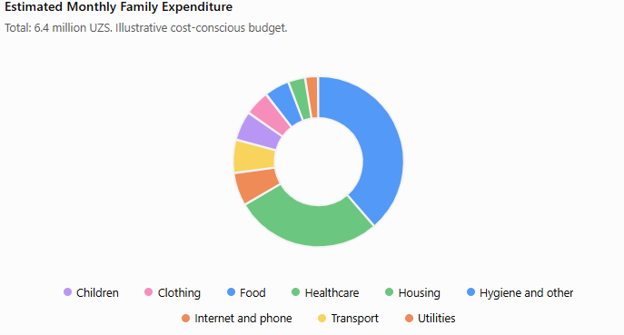
The estimated monthly household budget is UZS 6,400,000, representing a cost-conscious level of expenditure that covers accommodation, food, essential services, transportation, healthcare, and family needs.
2.1. Hourly Living-Cost Calculation
For comparison with the indicator’s hourly-wage requirement, the assessment assumes a standard full-time working schedule of 40 hours per week.
Average monthly working hours:
40 × 52 ÷ 12 = 173.33 hours.
Estimated hourly household living-cost benchmark:
6,400,000 ÷ 173.33 = approximately UZS 36,923 per hour.
Table 2. Household Expenditure Reference Indicators
Indicator | Amount |
Monthly household living expenses | 6,400,000 UZS |
Annual household living expenses | 76,800,000 UZS |
Average monthly working hours | 173.33 |
Hourly household expenditure benchmark | 36,923 UZS |
Academic Staff Salary Structure
Navoi State University applies an established academic remuneration system in accordance with the approved national salary framework.
The University’s academic staffing structure starts with the Teacher / Assistant position. There is no Trainee Teacher position in the University’s current staffing structure.
Table 3. Approved Basic Monthly Academic Salary Ranges
Academic Position | Minimum Salary (UZS) | Maximum Salary (UZS) |
Teacher / Assistant | 8,153,552 | 9,401,944 |
Senior Teacher | 9,167,869 | 10,650,334 |
Associate Professor | 10,221,197 | 12,210,822 |
Professor | 12,952,053 | 14,434,516 |
Head of Department | 12,522,918 | 15,136,736 |
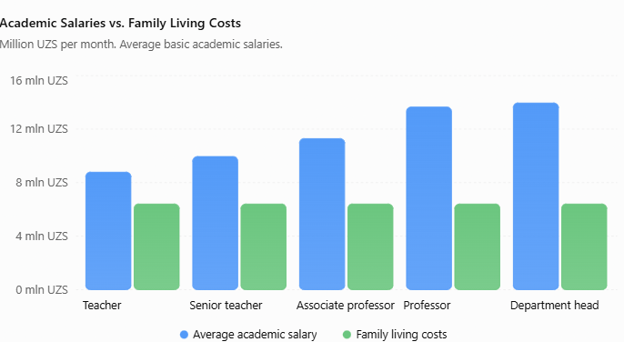
The lowest listed full-time academic salary is UZS 8,153,552 per month.
This exceeds the estimated monthly household expenditure of UZS 6,400,000 by UZS 1,753,552, equivalent to approximately 27.4%.
The established basic salary framework therefore provides positive evidence of remuneration adequacy for the academic positions reviewed.
Academic Salary Adequacy Assessment
To evaluate the purchasing power of academic salaries, the University compared average basic remuneration for each academic position with the estimated household expenditure benchmark.
Table 4. Comparison of Academic Salaries with Household Living Expenses
Academic Position | Average Monthly Salary (UZS) | Coverage of Household Expenses |
Teacher / Assistant | 8,777,747 | 137.2% |
Senior Teacher | 9,948,114 | 155.4% |
Associate Professor | 11,287,533 | 176.4% |
Professor | 13,654,272 | 213.3% |
Head of Department | 13,953,366 | 218.0% |
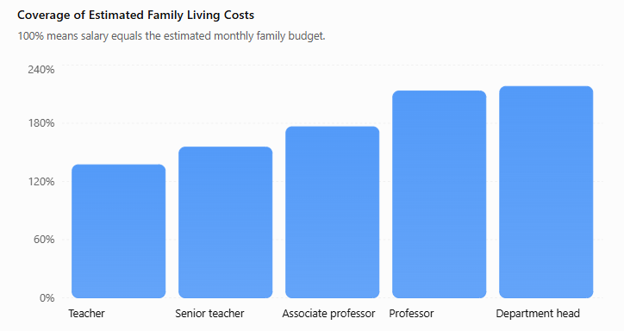
The comparison demonstrates that the average basic salaries of the reviewed academic positions exceed the estimated monthly household expenditure benchmark.
The average Teacher / Assistant salary covers approximately 137.2% of the estimated household expenses.
Senior Teachers receive average basic remuneration equivalent to approximately 155.4% of the benchmark, while Associate Professors receive approximately 176.4%.
The average salaries of Professors and Heads of Department exceed twice the estimated household expenditure.
These calculations are based on gross monthly basic salaries and an illustrative household budget. They do not represent individual net disposable income.
In addition to nationally regulated basic salaries, Navoi State University implements an institutional financial incentive system established through a Rector’s Order dated 17 May 2025.
The order regulates financial incentives for professors, teachers, and other eligible categories of university employees using extra-budgetary funds.
The purpose of this system is to encourage professional development, reward measurable achievements, improve educational quality, strengthen scientific productivity, and recognize employees’ contributions to institutional performance.
Financial rewards are granted according to the specific conditions and approval procedures established in the order.
5.1. Financial Incentives for Academic Degrees and Scientific Titles
The University’s incentive framework provides financial recognition for employees who obtain advanced academic degrees and scientific titles.
Table 6. Financial Incentives for Academic Achievements
Academic Achievement | Incentive |
Obtaining a PhD degree | 50% of monthly salary |
Obtaining a DSc degree | 100% of monthly salary |
Eligible doctoral dissertation defence at a Top-1000 internationally ranked institution | 200–300% of monthly salary |
Obtaining the title of Associate Professor | 50% of monthly salary |
Obtaining the title of Professor | 75% of monthly salary |
These incentives recognize the academic and scientific achievements of university employees.
The amounts are calculated as percentages of the relevant monthly salary, subject to the requirements specified in the Rector’s Order.
5.2. Incentives for Research and Scientific Publications
Navoi State University encourages scientific research and international academic visibility through financial rewards for research achievements.
The University’s incentive framework recognizes eligible achievements in the following areas:
Publication of scientific articles in internationally indexed journals, including Scopus and Web of Science.
Publication of scientific monographs and academic books.
Achievement of research performance indicators.
Obtaining patents and other recognized intellectual property results.
Contributions to research supervision and scientific development.
The Rector’s Order also provides financial recognition for achieving a Scopus H-index of 5, including a reward equivalent to 100% of the monthly salary under the specified conditions.
These mechanisms encourage academic employees to increase research productivity and contribute to the University’s international academic reputation.
5.3. Incentives for Teaching Excellence and Educational Innovation
The University provides financial incentives for employees who demonstrate outstanding teaching performance and contribute to educational innovation.
Eligible activities include developing modern teaching methodologies, improving course content, introducing digital learning technologies, preparing educational materials, and implementing innovative approaches to student learning.
Depending on the achievement category, the Rector’s Order establishes incentives including 25%, 50%, and up to 100% of monthly salary.
These rewards encourage continuous improvement in educational quality and recognize employees’ contributions beyond their regular teaching responsibilities.
5.4. Incentives for Internationalization and Foreign Language Education
Navoi State University supports the internationalization of higher education by recognizing employees who contribute to foreign-language teaching and internationally oriented educational activities.
The institutional incentive framework includes rewards for eligible educational activities delivered in foreign languages, including English, French, German, and other languages.
For specified eligible activities, the Rector’s Order provides an incentive equivalent to 100% of the employee’s monthly salary.
This measure supports the development of international educational programmes and encourages academic staff to strengthen their professional and language competencies.
5.5. Incentives for Institutional Development
The University’s incentive framework also recognizes contributions to institutional performance and development.
Eligible activities include improving educational infrastructure, introducing innovative administrative practices, developing academic resources, and successfully implementing institutional initiatives.
The Rector’s Order provides differentiated incentive rates depending on the achievement category, including rewards of 25%, 50%, and 100% of monthly salary.
These incentives strengthen employee motivation and support the University’s long-term institutional development.
Financial Incentive Administration and Accountability
The University administers financial rewards through established internal procedures.
Financial incentives are based on documented achievements and the relevant supporting materials.
Applications and supporting documents are reviewed through the appropriate university structures, and rewards are approved according to the institutional procedures established by the Rector’s Order.
The system operates within the limits of available extra-budgetary resources and applicable national financial regulations.
The University also provides for eligible employee financial assistance under the conditions specified in its internal regulations.
The incentive framework complements the established salary system and is designed to recognize additional achievements rather than replace employees’ basic remuneration.
Institutional Monitoring and Continuous Improvement
Navoi State University recognizes the importance of regularly reviewing employee remuneration in relation to changing living expenses and economic conditions.
The University’s approved salary schedules and analytical reports provide a basis for assessing academic salary adequacy.
The University aims to strengthen this assessment through periodic review of salary levels, household expenditure indicators, and financial incentive implementation.
Future institution-wide assessments will also incorporate non-academic staff categories, employment fractions, and working-hours information to provide a comprehensive evaluation of compliance with the living-wage indicator.
National Legal Framework for Trade Union Recognition
Navoi State University recognizes trade unions within the legal framework established by the Republic of Uzbekistan.
The Law of the Republic of Uzbekistan No. O‘RQ-588, On Trade Unions, provides the principal legal foundation for freedom of association and the protection of employees’ collective labour rights.
In particular:
Article 4 establishes the right to voluntarily establish and join trade unions.
Article 5 establishes the principles of voluntariness, non-discrimination, independence, equality, transparency, and openness.
Article 7 protects voluntary membership and prohibits compulsory membership or withdrawal.
Article 8 prohibits discrimination based on trade union membership or non-membership.
Articles 9–10 protect trade union independence and the equality of members.
Article 12 provides safeguards against unlawful interference in trade union activities.
These provisions establish the legal basis for recognizing trade unions as independent organizations representing employees’ legitimate interests.
1.2. Law No. O‘RQ-798 – Labour Code of the Republic of Uzbekistan
The Labour Code of the Republic of Uzbekistan, approved by Law No. O‘RQ-798, provides the broader legal framework governing employment relationships, collective labour relations, working conditions, and the protection of employees’ rights.
Navoi State University applies this framework in its employment relations and cooperation with employee representative bodies.
The University recognizes the importance of collective agreements, social dialogue, fair employment practices, and the lawful resolution of workplace disputes.
Navoi State University has established a Primary Trade Union Organization responsible for representing employees’ labour, socio-economic, and legitimate interests.
The organization’s activities are governed by the Regulations on the Primary Trade Union Organization of Navoi State University, which define its objectives, membership principles, organizational structure, governing bodies, responsibilities, and cooperation with university administration.
According to Section 1.6 of the Regulations, the Trade Union protects the interests of the following categories of employees:
Employee category | Scope of representation |
Academic and teaching staff | Employment rights, remuneration, working conditions |
Research staff | Professional and labour-related interests |
Administrative and managerial personnel | Employment conditions and social protection |
Educational support staff | Labour rights and workplace welfare |
Technical and service staff | Occupational safety and social guarantees |
Women employees | Equal treatment and protection against discrimination |
International employees | Protection of legitimate labour rights under applicable legislation |
The organization operates through its general meeting or conference, elected Trade Union Committee, and Chairperson.
Its governing arrangements provide opportunities for members to participate in organizational decision-making, submit proposals, elect representatives, and raise employment-related concerns.
Equal Recognition of Women and International Staff
3.1. Recognition and Protection of Women Employees
Navoi State University recognizes the importance of ensuring equal opportunities and protecting the labour rights of women employees.
Women working in academic, research, administrative, technical, and service positions are covered by the University’s general labour-rights protection framework.
Through trade union representation, women employees may seek assistance concerning employment conditions, remuneration, working hours, leave entitlements, occupational health and safety, workplace disputes, and social protection.
The University recognizes that participation in trade union activities must not become a basis for discrimination, unequal treatment, or restrictions on professional advancement.
3.2. Recognition and Protection of International Employees
Navoi State University values the contribution of international academic and professional staff to teaching, research, and international cooperation.
Section 4.5 of the University’s Trade Union Regulations explicitly recognizes the protection of the labour rights and legitimate interests of international employees legally employed by the University, without discrimination.
The Regulations provide that eligibility for trade union membership and representation is determined in accordance with applicable legislation and the relevant trade union charter.
Accordingly, the University recognizes the importance of ensuring that international employees can seek appropriate protection of their employment-related rights and interests through lawful institutional mechanisms.
This approach supports an inclusive working environment in which nationality and gender do not constitute grounds for discrimination in the protection of labour rights.
Collective Bargaining and Cooperation with University Administration
The University’s Trade Union Committee serves as an important mechanism for cooperation between university employees and management.
Its responsibilities include participating in the development, conclusion, implementation, and monitoring of collective agreements, as well as discussing matters affecting employees’ working conditions and socio-economic interests.
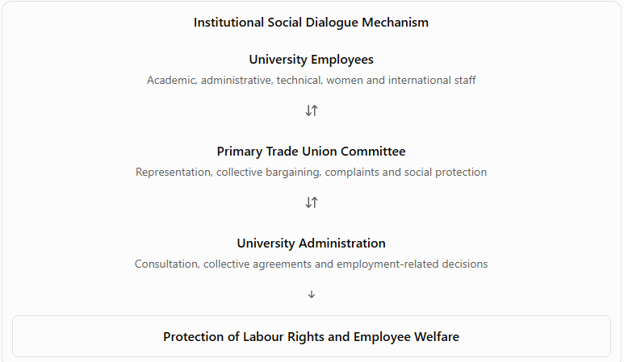
The Trade Union Committee’s areas of cooperation include the implementation of collective agreements, workplace safety, remuneration, leave, social guarantees, employee appeals, and the organization of welfare activities.
These arrangements strengthen social partnership and support transparent communication between the University and its employees.
Employee Complaints and Labour Rights Protection
Navoi State University recognizes the right of employees to raise concerns regarding employment conditions and possible violations of their labour rights.
The Trade Union Committee is authorized, within its competence, to receive and consider written and oral appeals, participate in resolving labour disputes, and represent employees’ interests in accordance with applicable legislation.
Where appropriate, the Committee may approach the university administration or competent authorities and assist employees in seeking lawful remedies.
This institutional mechanism contributes to the protection of employees’ rights and the promotion of fair employment practices.
Social Protection and Employee Welfare
In addition to representing labour rights, the University’s Trade Union Organization has responsibilities relating to employees’ social well-being.
These include providing or facilitating financial assistance, supporting health improvement and recreational opportunities, organizing cultural and educational activities, and promoting occupational health and safety.
The provision of such assistance is governed by applicable regulations, approved procedures, and available resources.
These functions demonstrate that trade union recognition at Navoi State University extends beyond formal employment representation to include the broader socio-economic interests of its workforce.
Navoi State University recognizes and supports the activities of its Primary Trade Union Organization as an institutional mechanism for protecting employees’ labour rights, promoting collective representation, and strengthening social partnership.
The University recognizes trade union representation across its academic, research, administrative, educational support, technical, and service workforce. Its internal regulations expressly protect the legitimate labour interests of women and international employees without discrimination.
By combining national legal guarantees with institutional trade union arrangements, Navoi State University demonstrates its commitment to decent work, equality, freedom of association, and the protection of employees’ socio-economic interests.
Institutional Commitment to Employee Rights and Fair Appeals
Navoi State University (NSU) is committed to protecting the employment rights, professional interests and financial entitlements of all academic, administrative and technical staff.
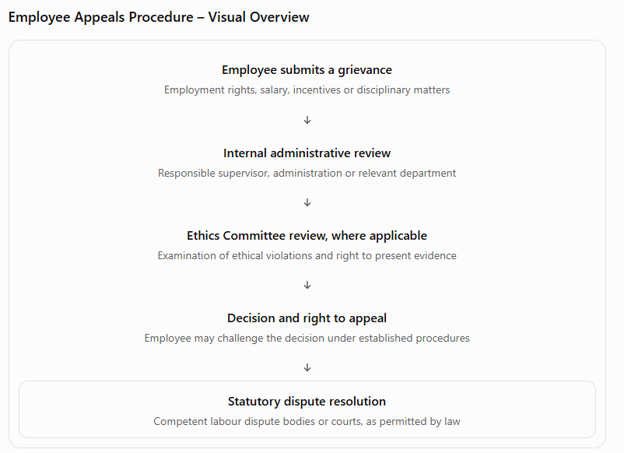
The University recognises employees’ rights to raise concerns, submit complaints, challenge employment-related decisions and seek fair resolution of disputes concerning working conditions, salaries, financial incentives, disciplinary measures and other employment matters.
These rights are supported by two principal regulatory frameworks:
The Labour Code of the Republic of Uzbekistan, adopted on 28 October 2022 (Law No. O‘RQ-798), which establishes statutory mechanisms for protecting labour rights and resolving employment disputes.
The Navoi State University Code of Ethics and Conduct, which establishes institutional principles of legality, fairness, impartiality and respect for employees’ rights, including the right to appeal university decisions.
The University applies these principles to support fair treatment, accountability and lawful resolution of employee grievances.
Legal Framework for Employee Appeals
The Labour Code of the Republic of Uzbekistan (Law No. O‘RQ-798, 28 October 2022) provides the national legal foundation for employees to defend their employment rights.
Article 4 establishes equality of labour rights and prohibits discrimination in employment. Employees who consider themselves victims of discrimination may challenge such treatment through legally established procedures, including judicial remedies.
The Labour Code also regulates individual labour disputes, employee representation, remuneration and the legal protection of employees against unlawful employment practices.
Accordingly, NSU employees are entitled to challenge employment-related decisions through the applicable internal and statutory procedures.
Internal Employee Grievance and Appeals Mechanisms
The University’s Code of Ethics and Conduct establishes institutional procedures for addressing concerns involving professional conduct, workplace relations and disciplinary decisions.
Article 6 – Protection of Rights and Legitimate Interests
The University recognises citizens’ rights, freedoms and legitimate interests as fundamental values. Where violations occur, university personnel are expected to assist in restoring those rights.
Article 17 – Responsibilities of University Leadership
University leaders must demonstrate fairness and impartiality, prevent discrimination in labour relations, avoid psychological or physical pressure, and take appropriate measures to address conflicts of interest.
Article 24 – Administrative Escalation
Issues arising between employees and university administration are addressed through the established chain of command, providing an institutional basis for escalating workplace concerns.
Article 32 – Ethics Committee
The University’s Ethics Committee may review alleged violations of the Code based on complaints and information received from employees, internal investigations, instructions from the Rector or its own initiative.
Article 33 – Right to Defend and Appeal
Faculty members and employees have the right to receive information concerning alleged violations and the review process, present evidence in their defence, and appeal university decisions in accordance with established procedures.
These provisions provide an institutional foundation for addressing employee grievances and reviewing decisions that may affect employees’ rights and professional interests.
Appeals Concerning Salaries and Financial Entitlements
Employees may raise disputes relating to salary payments and other financial entitlements under the applicable provisions of the Labour Code.
Such concerns may include:
Incorrect salary calculations or unpaid wages.
Delays in salary payments.
Disputes over allowances, bonuses or financial incentives.
Unlawful deductions from wages.
Disagreements regarding employment contracts and remuneration conditions.
Salary-related complaints can be submitted to the University administration for examination by the relevant responsible units, including financial and human resources personnel.
Where a dispute cannot be resolved internally, employees retain the right to use the statutory labour dispute resolution mechanisms established by Uzbekistan’s labour legislation.
Employee Representation and External Legal Remedies
The Labour Code recognises the role of employee representatives and trade unions in protecting workers’ lawful interests.
Employees may seek assistance from their trade union representatives in matters concerning employment conditions, remuneration and the protection of labour rights.
Where an internal resolution is unsuccessful or the employee chooses to exercise statutory rights, the employee may pursue remedies through the competent labour dispute resolution bodies or courts, as permitted by national legislation.
Fairness, Transparency and Accountability
Navoi State University’s grievance and appeals framework is guided by the following principles:
Accessibility: Employees have the right to raise concerns and challenge decisions affecting their employment.
Impartiality: Complaints and alleged ethical violations must be considered fairly.
Right to Defence: Employees may present evidence and explanations when their conduct or employment-related decisions are under review.
Legal Protection: Employees retain their rights to seek statutory remedies.
Accountability: University officials are required to respect labour legislation and institutional ethical standards.
The University’s Code of Ethics and Conduct expressly recognises employees’ rights to defend themselves and appeal university decisions, while the Labour Code of the Republic of Uzbekistan provides additional legal protection and formal dispute resolution mechanisms.
Together, these provisions support the University’s commitment to fair employment practices, transparent administration and the protection of employees’ rights in accordance with SDG 8 – Decent Work and Economic Growth.
Institutional Commitment to Gender Pay Equity
Navoi State University is committed to ensuring equal remuneration, transparent salary structures, and fair financial incentives for all employees, regardless of gender.
The University applies nationally regulated salary scales for academic and administrative personnel, supported by internal procedures governing performance-based remuneration, additional allowances, and financial incentives.
Our institutional approach is based on the principle that employees holding equivalent positions, with comparable qualifications, responsibilities, workloads, and professional performance, should receive remuneration according to the same established criteria, irrespective of whether they are women or men.
The University’s pay equity framework is supported by:
National regulations establishing standardized remuneration for higher education employees.
University-approved salary schedules differentiated by academic position and qualification.
Performance-based financial incentive procedures administered through a designated commission.
Participation of human resources, finance, internal monitoring, and trade union representatives in remuneration-related decisions.
Employment and payroll documentation that provides a basis for examining remuneration by gender and position.
These mechanisms establish a foundation for gender-responsive salary monitoring and the identification of potential pay inequalities.
Standardized Salary Structure and Gender-Neutral Remuneration
The University implements salary scales determined by academic position, qualifications, and applicable national remuneration regulations.
The following figures are derived from the University’s submitted salary statistics.
Academic position | Monthly base salary range (UZS) | Reference average (UZS) |
Teacher / Assistant | 8,153,552–9,401,944 | 8,777,747 |
Senior Teacher | 9,167,869–10,650,334 | 9,948,114 |
Associate Professor | 10,221,197–12,210,822 | 11,287,533 |
Professor | 12,952,053–14,434,516 | 13,654,272 |
Head of Department | 12,522,918–15,136,736 | 13,953,366 |
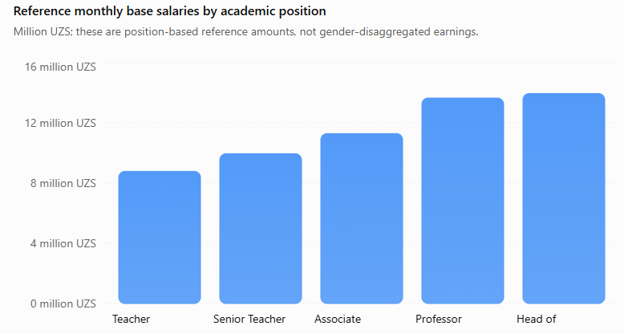
The standardized salary structure establishes common remuneration criteria for employees occupying comparable academic positions. Gender is not specified as a determinant of the salary rates presented in the approved scale.
Salary differences may arise from academic qualifications, professional rank, workload, length of service, additional responsibilities, and applicable performance-related allowances.
Accordingly, the University distinguishes between legitimate differences arising from professional criteria and potential unexplained differences requiring further review.
Financial Incentives and Fair Remuneration
In addition to base salaries, Navoi State University operates a performance-based financial incentive system.
Under the University’s Procedure for Financial Incentives and Support, remuneration-related decisions are guided by impartiality, transparency, and measurable performance indicators.
The incentive system considers academic achievements, research productivity, additional teaching responsibilities, professional performance, and contributions to institutional development.
The University’s regulations provide for:
Performance-based bonuses assessed through the KPI system, including incentive decisions in January and September.
Financial assistance of up to ten times the applicable minimum wage in specified personal or emergency circumstances.
Additional remuneration for eligible academic qualifications and professional achievements.
Periodic evaluation of incentive decisions and the possibility of revising payments based on performance.
The Financial Incentive Commission includes representatives of the Finance Department, Human Resources Department, Trade Union Committee, Education Quality Control Department, and Internal Monitoring Department.
This structure provides institutional oversight of remuneration decisions and a mechanism through which potential concerns about unequal financial treatment can be examined.
Gender Pay Equity Monitoring Framework
The University can assess gender pay equity by comparing the actual remuneration of female and male employees within equivalent academic and administrative categories.
The proposed monitoring framework covers base salaries, additional allowances, KPI bonuses, total remuneration, workload, and professional qualifications.
Monitoring indicator | Measurement |
Base salary equity | Average salary by gender within the same position |
Gender pay gap | Percentage difference in average male and female earnings |
Bonus distribution | Average KPI and incentive payments by gender |
Academic rank | Female and male representation across salary grades |
Workload-adjusted pay | Remuneration compared on a full-time-equivalent basis |
Pay equity review | Identification and examination of unexplained differences |
The standard gender pay gap calculation is:

A zero-percent result indicates equal average pay for the employees being compared. However, standardized salary scales alone cannot establish that the actual gender pay gap is zero, because bonuses, workload, seniority, and the distribution of employees across positions may affect total earnings.
Illustrative Gender Pay Equity Analysis
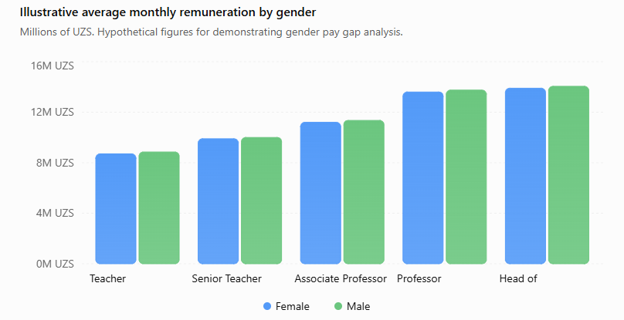
The following table demonstrates how the University can present gender-disaggregated payroll statistics. The figures are illustrative calculations, not verified University payroll results.
Academic position | Female average (UZS) | Male average (UZS) | Illustrative gap |
Teacher | 8,700,000 | 8,850,000 | 1.69% |
Senior Teacher | 9,900,000 | 10,000,000 | 1.00% |
Associate Professor | 11,200,000 | 11,350,000 | 1.32% |
Professor | 13,600,000 | 13,750,000 | 1.09% |
Head of Department | 13,900,000 | 14,050,000 | 1.07% |
Institutional Oversight and Continuous Improvement