5. Key Takeaways & SDG 5 Recommendations
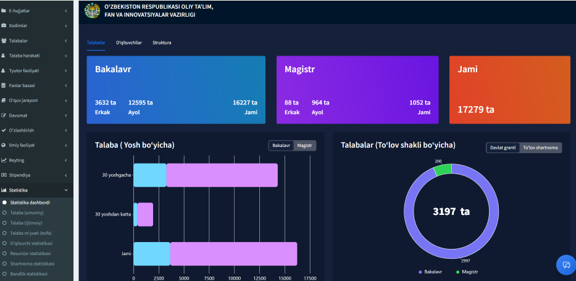
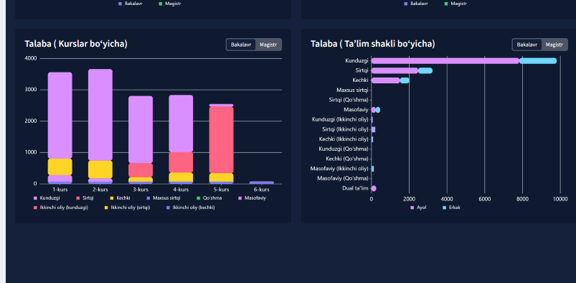
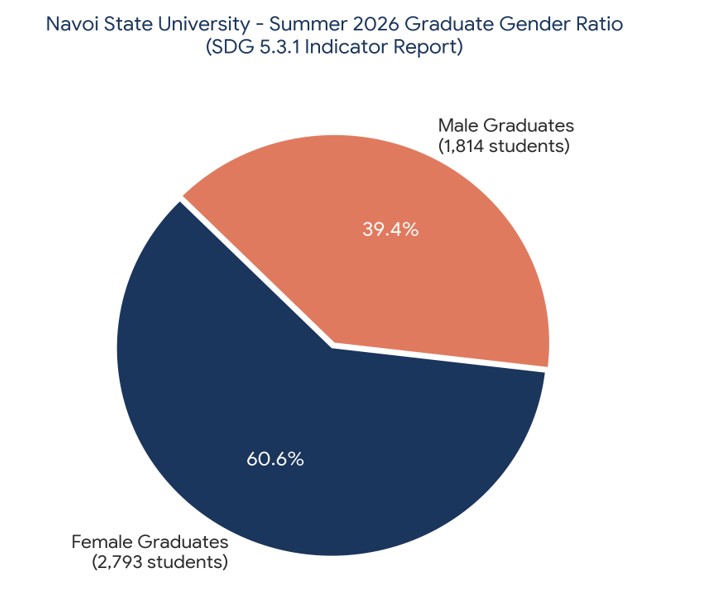
Female Leadership in Higher Education: Women account for over 60% of total university graduates, demonstrating Navoi State University’s pivotal role in empowering female professionals in Uzbekistan.
STEM & Male/Female Parity Initiatives: While Education and Languages see high female enrollment (80%+), STEM fields (Exact Sciences, Natural Sciences) show opportunities for further incentive programs to encourage balanced participation.
Postgraduate Advancement: Master’s degree graduates total 227 (4.93%). University policy should continue supporting female research grants to further increase women’s representation in academic and research careers.
3. Gender Comparison Methodology
For each entering cohort and degree level, compare female and male completion rates using the same observation period. Female completion rate = female cohort members graduating ÷ female cohort entrants × 100; male completion rate = male cohort members graduating ÷ male cohort entrants × 100. The gender gap is the difference between these rates in percentage points. Where appropriate, report retention, progression, withdrawals and completion within the expected study duration. Distinguish cohort-based graduation likelihood from the percentage of all graduates who are women.
4. Early-Warning, Mentoring and Academic Support
Systematic academic monitoring
Faculty staff review HEMIS-based grades, credits, academic debts and attendance to detect academic difficulty early. Individual consultations, subject-specific help and catch-up activities are provided where needed.
Tutor–student mentoring
Tutors maintain contact with students, discuss academic progress, personal development and career plans, and refer students to faculty or specialist services when necessary.
Attendance and engagement follow-up
Repeated absence triggers tutor contact and review of underlying barriers, including family, housing or financial circumstances, with faculty intervention where appropriate.
Academic recovery and peer support
Additional instructor consultations, group study and peer-support activities are used to help students experiencing difficulty with coursework or assessment.
Psychological and social well-being
University psychologists, women’s affairs coordinators and tutors offer counselling and awareness activities on stress, motivation, healthy relationships and social adaptation.
Student engagement and empowerment
Research, clubs, competitions, sports, volunteer programmes and leadership opportunities strengthen belonging, confidence and continued participation in university life.
5. Financial, Entrepreneurship and Career Support
The monitoring evidence describes guidance on scholarships, financial assistance, entrepreneurship programmes, internships and professional training. It also references national and regional initiatives, including HAMROH, preferential financing and business incubation. Such external schemes should be presented as available support pathways rather than as university-funded awards unless award records verify direct NSU participation.
The career-opportunities evidence describes concrete employer engagement and career guidance events. These activities help graduating students—including women—prepare for work, develop professional networks and explore entrepreneurship. Event records do not, on their own, establish a measured reduction in gender-specific graduation gaps.
6. Career Outreach
Leader and Youth — dialogue with public officials
University and regional leaders met students and graduating youth to discuss education quality, employment, entrepreneurship, innovation and the “Kelajakka qadam” programme, including preferential finance and business-startup opportunities.
Employment guidance for Languages students
The Career and Employment Department and “Kelajakka qadam” Centre provided guidance on the osonish.uz platform, job vacancies, entrepreneurship, CV preparation and interviews to final-year language students.
Career Day — university job fair
The university reports participation by more than 2,000 students and approximately 40 employers. Graduating students were able to engage with employers and sign preliminary employment agreements.
Regional Labor Fair — employer partnerships
The regional fair brought together more than 50 organizations and offered more than 12,000 advertised vacancies. University representatives negotiated cooperation arrangements and around 10 graduates signed preliminary employment contracts.
Economics Faculty — April 8–9 Labor Fair
Economics students attended interviews and explored sector-specific vacancies; the supplied report states that six graduating students signed employment contracts with Baxt Textile LLC.