Navoi State University’s Commitment to a Clean and Renewable Energy Future
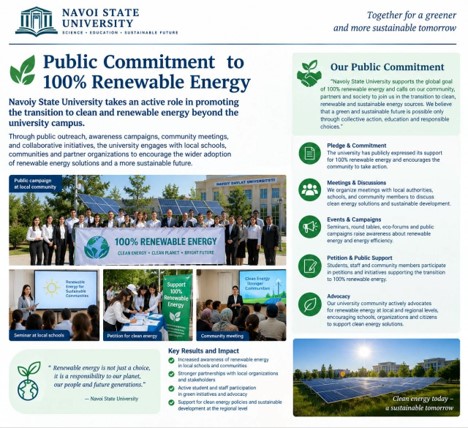
Navoiy State University recognizes the transition to clean and renewable energy as an essential part of sustainable development and climate responsibility. The University supports the wider adoption of renewable energy technologies and promotes energy efficiency as important components of a sustainable future.
Through its sustainability activities, Navoiy State University seeks to contribute to Uzbekistan’s transition toward a greener economy and to encourage students, academic staff, schools, local communities and partner organizations to recognize the importance of clean and renewable energy.
The University’s commitment is reflected in its ongoing sustainability initiatives, including Green Campus activities, energy conservation measures, renewable-energy awareness programmes, solar-energy applications and educational activities related to sustainable energy management.
Meetings and Discussions Promoting Renewable Energy Beyond the University
Navoiy State University actively promotes public discussion and awareness of renewable energy beyond the university campus. Through educational meetings, community discussions and outreach activities, the University communicates the importance of clean energy, renewable-energy technologies and environmentally responsible practices to local communities and school students.
Community Awareness Meetings
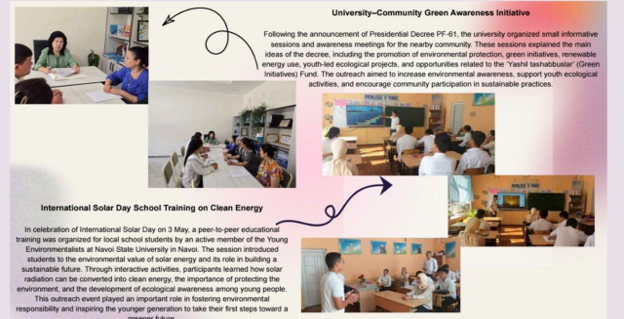
Following the announcement of Presidential Decree PF-61, Navoiy State University organized informative sessions and awareness meetings for members of the nearby community.
The meetings introduced participants to environmental protection, green initiatives, renewable energy use and opportunities for youth participation in ecological projects. Particular attention was given to the “Yashil tashabbuslar” (Green Initiatives) Fund, which provides opportunities for young people to participate in environmental initiatives.
The meetings were designed to increase environmental awareness and encourage community members to participate in sustainable practices and green initiatives.
International Solar Day — Clean Energy Discussion
An important example of the University’s renewable-energy outreach was the International Solar Day educational activity held on 3 May.
As part of the activity, an active member of the Young Environmentalists at Navoiy State University conducted a peer-to-peer educational training for local school students.
During the training, participants discussed:
the environmental value of solar energy;
how solar radiation can be converted into clean electricity;
the role of solar energy in sustainable development;
environmental protection;
renewable-energy technologies; and
the importance of developing environmental awareness among young people.
The activity allowed university students to share their knowledge of clean energy directly with school students outside the University. It therefore represents an example of university-led renewable-energy awareness and advocacy extending into the wider community.
Community Dialogue and Environmental Awareness
These meetings and discussions create a direct connection between the University and the wider community. Instead of limiting renewable-energy education to university classrooms, NSU provides opportunities for school students and community members to learn about clean energy and discuss practical environmental solutions.
Through this approach, the University encourages:
greater awareness of renewable-energy technologies;
understanding of the environmental benefits of solar energy;
youth participation in green initiatives;
community involvement in environmental protection;
responsible energy consumption; and
wider public support for the transition toward renewable energy.
Impact Beyond the University
The activities demonstrate that Navoiy State University’s sustainability work extends beyond its physical campus. University students act as knowledge-sharing participants, communicating renewable-energy concepts to school students and community members.
This outreach contributes to the development of a broader sustainability culture in the local community and supports the long-term objective of increasing public understanding and acceptance of renewable-energy solutions.
One Appeal – One Clean Area – One Big Change!
Following an environmental appeal submitted through the website of the International Youth Ecological Committee, https://youtheco.org/ , a plogging campaign was organized on Samarkand Street in Karmana District in cooperation with the Student Council of Navoiy State University.
After reviewing the area identified in the appeal, it was found that waste had accumulated around one of the residential properties located along the street, negatively affecting the cleanliness and sanitary condition of the surrounding area.
During the campaign, the area was thoroughly cleaned and the accumulated waste was removed. In addition, a preventive and awareness-raising conversation was held with the homeowner. The importance of taking responsibility for the environment, maintaining cleanliness in the surrounding area, and avoiding the disposal of waste in unauthorized locations was explained.
Importantly, environmentally conscious young people and local activists also joined the initiative and actively participated in the clean-up activities. Their participation demonstrated the importance of community engagement and collective responsibility in protecting the local environment.
Participants who actively contributed to the plogging campaign were presented with commemorative gifts in recognition of their involvement.
A clean environment means a healthy environment. Every member of society has a responsibility to protect nature and maintain the cleanliness of our surroundings.
Evidence of community engagement:
This activity demonstrates Navoiy State University’s cooperation with young people, local residents and community activists in responding to environmental concerns raised by the public and taking practical action to improve the local environment.
Establishment of a Green Energy Research and Training Facility at Navoi State University
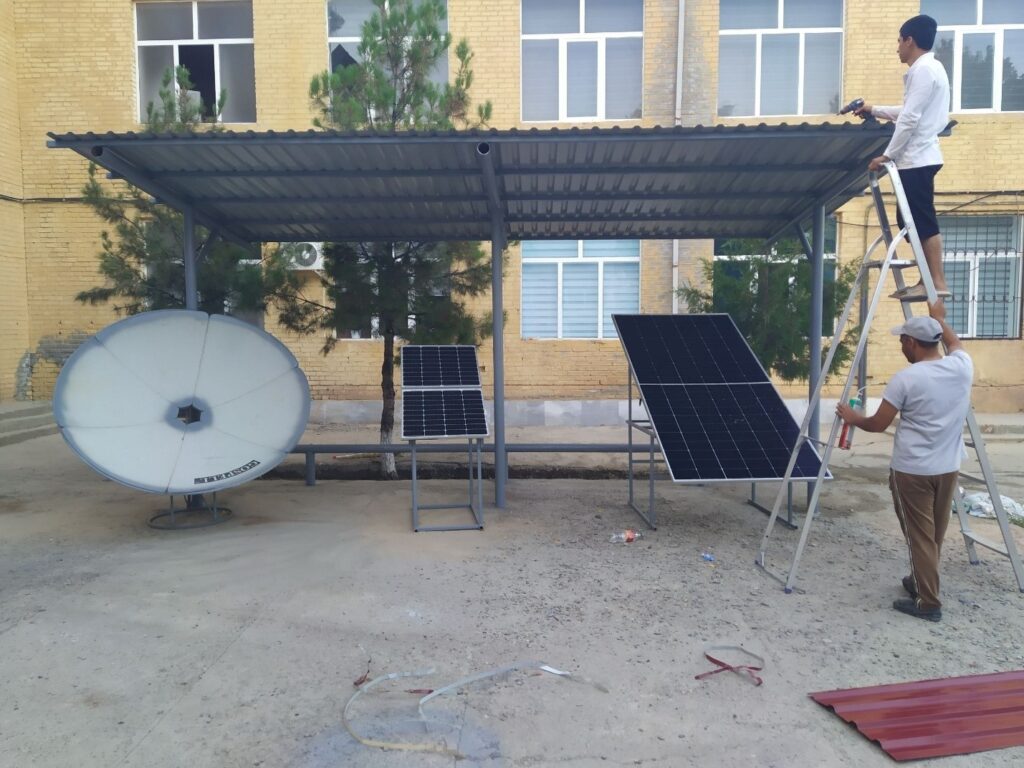
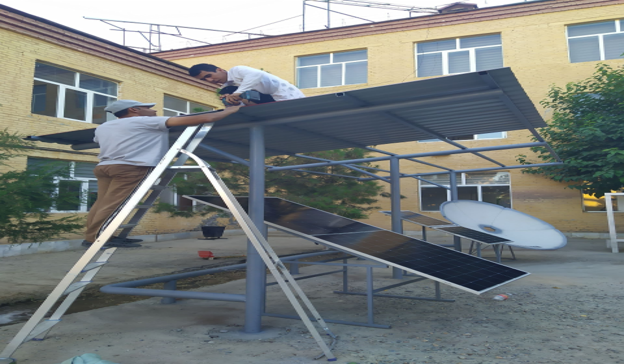
As part of the “90 Days of Action” initiative, the Department of Physics and Astronomy at Navoi State University is making progress in establishing a Green Energy Research and Training Facility in cooperation with NAVOIY GOLD LLC.
To date, two mini photovoltaic power stations have been successfully installed and commissioned at the facility. In the coming days, additional renewable energy technologies will be introduced, including a solar cooker, a solar water heater, a solar fruit dryer, and a SMART STOP intelligent bench.
The initiative aims to strengthen students’ practical skills, provide hands-on experience with renewable energy technologies, and promote research and innovation in sustainable energy solutions. The facility will serve as a practical learning environment where students can explore the applications of solar energy and develop competencies relevant to the transition towards cleaner energy systems.
Through this initiative, Navoi State University demonstrates its commitment to renewable energy education, sustainable campus development, and the promotion of green technologies.
Cooperation with Local Industry to Promote Renewable Energy
Navoi State University promotes the development of renewable energy through cooperation between academic departments and industrial enterprises. One relevant initiative is the establishment of the Green Energy Scientific and Educational Platform by the Department of Physics and Astronomy in cooperation with NAVOIY GOLD LLC. This initiative demonstrates how collaboration between a higher education institution and the business sector can support the practical application of renewable energy technologies.
The platform includes two mini photovoltaic power stations, a smart solar-powered bench known as “SMART STOP”, and a prototype solar cooker. These facilities provide practical examples of how solar energy can be used for electricity generation and everyday applications. They also create opportunities for students and researchers to explore clean energy technologies, understand their benefits and develop practical skills related to sustainable energy production.
Cooperation between the university and industry is important because businesses play a significant role in energy consumption and the transition towards more sustainable production methods. By connecting academic research with industrial experience, the university can help identify opportunities to improve energy efficiency, reduce unnecessary electricity consumption and encourage the adoption of environmentally friendly technologies.
Such cooperation also provides a foundation for strengthening communication between researchers, businesses, students and the wider community. For example, joint educational seminars, technical workshops and public discussions could explain the advantages of solar power, the importance of energy conservation and the economic and environmental benefits of renewable energy. These activities could be extended to local enterprises, schools, community organisations and other interested groups outside the university campus.
The university could further develop this collaboration by inviting industry specialists to deliver presentations, arranging educational visits to renewable energy facilities, and organising practical demonstrations of solar technologies. Students could participate in research projects that examine energy consumption, explore possible solar energy applications and propose solutions to local energy challenges. The results could then be shared through public presentations, educational materials and community awareness campaigns.
Cooperation with local industry can therefore contribute to building a stronger culture of environmental responsibility and promoting the wider use of renewable energy in the Navoi region. It can also encourage knowledge exchange between educational institutions and businesses, support the development of young specialists, and create opportunities for future joint initiatives in clean energy and sustainable development.
Through the Green Energy Scientific and Educational Platform and its cooperation with industrial partners, Navoi State University has a basis for expanding its contribution to renewable energy awareness beyond the campus. Further documented outreach activities and public commitments could strengthen the university’s contribution to the broader transition towards 100% renewable energy.

Innovating for a Sustainable Future: The “Green Energy” Platform is Ready
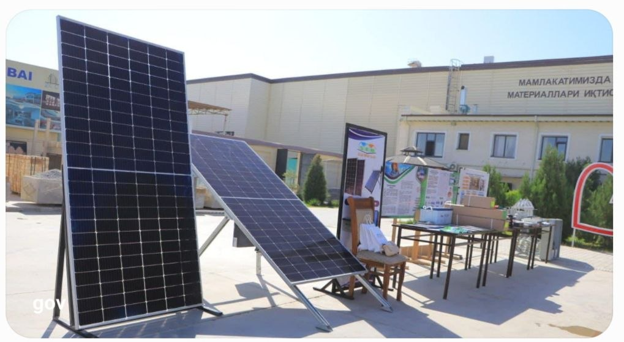
The “Green Energy” Scientific and Educational Platform is ready for operation! Starting from the 2026–2027 academic year, master’s degree students specializing in “Renewable Energy Sources” will have the opportunity to conduct their scientific and educational laboratory work at the “Green Energy” scientific and educational platform, established under the Department of Physics and Astronomy at Navoi State University in cooperation with “NAVOIY GOLD” LLC.
The construction and equipping of this platform were carried out by the professors, teachers, and staff of the department. To date, the following have been built and installed for use:
Two mini photovoltaic power stations;
A “SMART STOP” smart bench;
A solar kitchen prototype.
Expanding Horizons in Renewable Energy Education
The launch of the “Green Energy” platform at Navoi State University marks a significant step forward in integrating practical engineering with academic research. Here is why this initiative is so impactful:
Bridging Theory and Practice: While master’s students study advanced concepts in renewable energy theory, having an active outdoor platform allows them to test solar panels, analyze real-time power generation efficiency, and study environmental impacts firsthand.
Industry Collaboration: Partnering with “NAVOIY GOLD” LLC ensures that students get a glimpse of industry standards, bridging the gap between university laboratories and commercial-scale green technologies.
Smart Infrastructure on Campus:
The mini photovoltaic stations provide baseline data on solar power generation in local climate conditions.
The “SMART STOP” bench demonstrates how IoT (Internet of Things) and solar power can be merged into public urban utilities (e.g., providing phone charging or local lighting using clean energy).
The solar kitchen prototype highlights alternative, off-grid cooking solutions using concentrated solar thermal energy, which is highly relevant for remote or sun-rich regions.
Future Prospects: As global demand for sustainability grows, initiatives like this prepare highly skilled specialists who can design, maintain, and innovate green technologies for Uzbekistan’s rapidly developing energy sector.