STARTUP CLUB AND INNOVATION PROJECTS
AT NAVOI STATE UNIVERSITY
The website of the Navoi State University Startup Club and Incubation and Acceleration Centre (https://startup.nsuni.uz/ ) is the university’s online point of reference for its startup and innovation activity. It is intended to make information about student entrepreneurship and innovative projects easier to access and to present the university’s efforts to turn ideas into practical initiatives.
A university startup ecosystem can connect students, academic staff, mentors, potential partners and the wider community. Through such an ecosystem, students can identify real-world problems, develop solutions, test ideas, improve business models and learn how to present projects to competitions or potential supporters. Incubation and acceleration activities generally help early-stage projects progress from an idea to a prototype, pilot or more developed business proposition. The exact services and current activities of the Centre should be confirmed against the live website and official university announcements.
For sustainability reporting, the website is relevant as a potential source of evidence about innovation, entrepreneurship, skills development and the practical application of university knowledge. Strong evidence should include project profiles, official photographs, competition announcements, implementation records, partnerships and measurable outcomes.
Verification note: The detailed descriptions and environmental impacts of individual startups must be verified against their official project pages or supporting university documentation before being presented as confirmed evidence sustainability ranking.
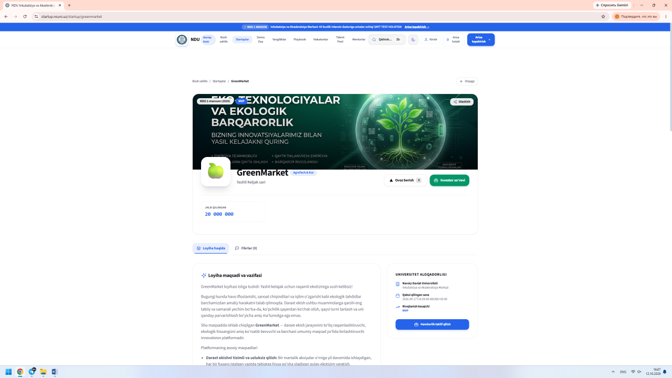
Digital Ecosystem for Urban Afforestation & Low-Carbon Technology
Category / Focus Area | AgroTech & Eco / Low-Carbon Technology |
Raised Capital / Funding | 20,000,000 UZS |
Development Stage | MVP (Minimum Viable Product) |
Incubation Program | NDU Incubation & Acceleration Center (Season 1, 2026) |
Community Votes | 3 Votes |
Project Background & Mission
GreenMarket is an innovative digital platform designed to digitize and automate the tree-planting process, quantify personal and institutional ecological contributions, and unify citizens, businesses, and plant nurseries toward regional climate resilience. Addressing critical threats such as atmospheric air pollution, industrial waste, and climate change, GreenMarket turns tree planting into a continuous, measurable, and accessible ecosystem.
Primary Platform Objectives
Continuous & Systematic Urban Afforestation: Transitions tree-planting efforts from one-time campaigns into a year-round, seamless digital ecosystem where every citizen can contribute continuously.
Online Marketplace & Smart Logistics: Enables users to select, order, and arrange delivery of fruit and ornamental saplings tailored to local soil and microclimate conditions directly from home.
Transparent Monitoring & Digital Certification: Assigns a unique QR-code digital certificate to every purchased tree, enabling real-time geolocation tracking of planting progress, plant survival, and ecological benefits.
Quantitative CO₂ Sequestration Tracking: Features a dedicated interactive carbon calculator to monitor annual carbon dioxide absorption rates of planted trees in real time.
Corporate Social Responsibility (CSR) Support: Provides corporate entities with a specialized dashboard to participate in urban green space development, generate formal ESG/ecological reports, and elevate institutional reputation.
Market Expansion for Local Nurseries & Farmers: Creates a direct-to-consumer digital marketplace for independent plant growers and nursery owners, boosting local agricultural incomes.
Innovative Technological Capabilities
AI Botanical Consultant: Integrates artificial intelligence algorithms to instantaneously evaluate regional climate and soil data, recommending optimal plant species for maximum survival.
Augmented Reality (AR) Visualization: Allows users to virtually project saplings in their courtyard or street via mobile phone cameras prior to purchasing.
Gamification & Rating System: Encourages sustained eco-conscious engagement by awarding specialized badges, points, and achievement ranks for verified environmental contributions.
Alignment with UI GreenMetric & Low-Carbon Criteria
Low-Carbon Economy & Carbon Offset (EC): Directly drives carbon sequestration through targeted afforestation and provides empirical CO₂ absorption metrics for climate adaptation.
Setting & Infrastructure (SI): Facilitates urban green canopy coverage, mitigation of the urban heat island effect, and sustainable land management.
DATE: 2026.09.18
GreenMarket transforms passive ecological awareness into quantifiable climate action. By systematically tracking CO₂ reduction metrics, empowering local agro-entrepreneurs, and streamlining institutional CSR initiatives, the startup establishes an expandable, low-carbon blueprint that significantly strengthens Navoi State University’s global sustainability indicators and environmental stewardship leadership.
Baseline income: 4,500 USD
• Revenue / Target ARR: 11,200 USD
• Employees / Team: 6 personnel
Description
Developed within the Incubation and Acceleration Center of Navoi State University, EcoFuqaro was created as an innovative response to unauthorized waste dumping and unmanaged urban environmental degradation. Recognizing that public reporting is often slow and disconnected, the team leveraged modern mobile technologies to empower citizens to act as real-time ecological guardians.
Aims and Mission
The primary mission of EcoFuqaro is to maintain regional ecological health, optimize municipal waste tracking, and enhance local governance through civic tech. The project’s scope involves implementing an advanced reporting network where local ecological violations, overflowing waste disposal bins, and damaged urban greenery can be mapped, analyzed, and quickly resolved by municipal response teams. The startup provides a specialized mobile application that enables citizens to instantly report localized environmental challenges using real-time GPS coordinates. By integrating Big Data analytics and Artificial Intelligence (AI) systems, the platform processes incoming civic data to optimize environmental monitoring, streamline waste management responses, and enhance urban ecological sustainability.
Scope of Work
Focuses on operating smart monitoring and eco-reporting platforms for environmental restoration. The startup collaborates with agricultural organizations, environmental agencies, and local communities to implement large-scale monitoring and land-rehabilitation projects.
Primary Product / Activity
The startup produces and maintains the mobile application and system hosted at ecofuqaro.uz. Utilizing integrated geolocation services, Artificial Intelligence (AI) for automatic image classification, and Big Data analytics, the app allows users to photograph and instantly report local environmental issues. The backend system compiles these geo-tagged reports, analyzes pollution trends across city districts, and delivers structured dashboards to public utility services to ensure swift, accountable, and transparent ecological management.
3. Smart Stop – Smart Bench with Solar Panel
Baseline Income: 300 – 350 USD
• Revenue / Target ARR: 400,000 – 500,000 USD
• Employees / Team: Project Manager – Management Specialist, Technical Director – Engineer, Marketing Manager – Advertising and Sales
Description
Today, renewable energy is recognized as the energy of the future, and every renewable energy source represents an investment in sustainability. The Smart Stop project is an innovative solution designed to integrate renewable energy technology into everyday urban life. This smart bench uses solar panels to generate electricity and offers multiple public utilities in one intelligent, eco-friendly design.
Problem Addressed
The project aims to solve several urban infrastructure problems, such as:
Frequent power outages;
Lack of public comfort features, including lighting and charging ports;
Absence of information systems and digital connectivity in public spaces.
Expected Results and Functions
Through the implementation of the Smart Stop – Smart Bench with Solar Panel project, the following outcomes will be achieved:
Generation of electricity using solar panels;
LED lighting system for night visibility;
USB charging ports for mobile devices;
Real-time schedule display for public transport;
Wi-Fi hotspot for free internet access;
Temperature monitoring sensors;
Security camera and emergency (SOS) button;
Digital advertising screen for informational and commercial purposes.
Technical Specifications
Solar panels: 1.2 kW
Battery capacity: 1 kW
Smart display + Wi-Fi system
LED monitor
Dimensions:
Height: 2.2 m
Front length: 3.0 m
Side length: 1.5 m
Impact
The Smart Stop project combines modern technology, renewable energy, and urban comfort to create sustainable, intelligent public spaces. It contributes to energy efficiency, digital transformation, and smart city development, while promoting environmental awareness and user convenience.
4. Innovative Technology for Producing Polymer-Granules for Paving Blocks Through Plastic Waste Recycling
Baseline Income: 5,200 USD
• Revenue / Target ARR: 12,000 USD
• Employees / Team: 7 personnel for small-scale
Description
The startup was founded at the Incubation and Acceleration Center of Navoi State University as a green solution to mitigate plastic and polymer waste pollution. The project emerged from a critical environmental need to redirect non-biodegradable urban waste away from landfills and transform it into highly durable, sustainable building components.
Aims and Scope of Work
The primary objective of the startup is to implement resource-recovery mechanisms that support a circular economy within the construction industry. By sorting, cleaning, and melting down consumer and industrial polymer waste, the project manufactures high-grade recycled granules. The scope of work involves optimizing the formula for paving blocks (bruschatka), making infrastructure development more eco-conscious, and lowering the carbon footprint associated with traditional concrete or virgin plastic manufacturing.
Environmental Impact
The startup provides a profound environmental benefit by introducing a closed-loop recycling mechanism that diverts hazardous polymer and plastic waste from local landfills. Since conventional plastics require hundreds of years to decompose, transforming them into reusable raw granules significantly prevents soil degradation, microplastic contamination, and groundwater pollution in the Navoi region.
Furthermore, integrating recycled polymer granules into the manufacturing of paving blocks reduces the demand for virgin plastic resins and traditional concrete components, thereby lowering the massive carbon footprint and energy consumption typically associated with raw material extraction and cement production. Through this automated recycling cycle, the project actively fosters a circular economy, enhances urban aesthetic infrastructure responsibly, and supports national initiatives for sustainable, eco-friendly construction practices.
Additional Benefits
Beyond its primary environmental goals, the project offers substantial socio-economic advantages for the local community and the construction sector. By converting plastic waste into high-grade granules, the startup creates a highly cost-effective alternative for paving block manufacturers, allowing them to lower production costs while increasing the durability, frost resistance, and lifespan of sidewalk tiles (trotuar plitka).
Additionally, the establishment of this processing cycle generates new green job opportunities within the region, specifically in waste collection, sorting, and technical processing operations. The initiative also serves as a practical, innovative framework for university researchers and students at the Incubation and Acceleration Center, providing a real-world testing ground for eco-friendly product development, engineering, and sustainable business management.
Primary Product / Activity
The startup specializes in the full-cycle production of recycled polymer granules specifically formulated as a binding and strengthening raw material for durable paving blocks and sidewalk tiles (trotuar plitka). The manufacturing process relies entirely on recycled plastics, ensuring that the resulting product is weather-resistant, durable, and structurally superior to conventional concrete materials. The company’s operations cover the collection of local plastic waste, high-tech extrusion and granulation, and the final supply of these raw materials to regional building and paving manufacturing enterprises.
Baseline Income: 7,000 USD (Requested/Initial investment)
• Revenue / Target ARR: $1.5M – $2.0M (Estimated Service Obtainable Market – SOM)
• Employees / Team: 5 personnel
Description
The “Digital Economy” startup, along with its core platform “Parvona,” was engineered within the Incubation and Acceleration Center of Navoi State University to solve a critical social-economic challenge in Uzbekistan. The project was born because modern families face extreme difficulty, anxiety, and hidden costs when trying to find trusted, pre-verified babysitters, nurses, or elderly caregivers through traditional, unregulated word-of-mouth networks.
Aims and Scope of Work
The main aim of the project is to build a safe, transparent, and digitalized care ecosystem that supports family welfare, youth employment, and gender equality. The scope of work involves conducting rigorous multi-layered background checks on caregivers (including mandatory psychological testing, criminal background screening, and medical examinations) and utilizing smart match-making algorithms to connect them with families across major cities like Tashkent, Samarkand, and Bukhara within 15 minutes.
Primary Product / Activity
The primary product is parvona.nsuni.uz, a comprehensive web and mobile ecosystem featuring detailed worker profiles, genuine customer feedback loops, and a standardized rating system. Operating on a financial model of a 10–15% transaction commission, premium family subscriptions, and a one-time provider registration fee, the platform targets a massive Total Available Market (TAM) of $50–70 million. By the end of its first year, it targets 500 active monthly placements generating $12,000 in monthly recurring revenue.
Environmental & Social Impact
While categorized under socio-economic digitalization, Parvona delivers a profound social sustainability impact. It directly drives gender equity by providing working mothers with a secure infrastructure to hand over caregiving duties safely, allowing them to resume their academic or professional careers without stress. Furthermore, by formalizing the local caregiving sector, the platform transitions informal, unprotected domestic workers into a transparent digital economy, ensuring fair wages, workplace safety, and structural employment for women and professional nursing graduates.
Additional Benefits
Beyond its immediate market value, the platform provides substantial educational and community relief. It serves as a practical, data-driven framework for students at the university studying the digital economy to analyze gig-economy trends, consumer behavior, and trust metrics in localized tech markets. Additionally, it offers a secure employment pipeline for young university graduates specializing in medicine, psychology, and pedagogy, enabling them to monetize their skills through verified part-time or full-time caregiving opportunities.
6. “Mini-Compost Capsule” – An Innovative Method for Solving Environmental Problems
Baseline Income: 6,000 USD
• Revenue / Target ARR: 25,000 USD
• Employees / Team: 8–10 total personnel (1 Project Leader, 1 Environmental Engineer, 1 Lab Technician, 2-3 Production, 2 Field Workers, 1 Finance/Logistics, 1-2 PR Coordinators)
Description & Aim
The main aim of this project is to reduce household organic waste and transform it into a valuable eco-friendly product — natural compost. The “Mini-Compost Capsule” technology offers a sustainable and innovative approach to addressing soil and air pollution caused by food waste.
Scope:
This project targets household organic waste such as fruit, vegetable, and bread leftovers. It focuses on raising public awareness about environmental protection and promoting green lifestyles among youth and local communities. The project is applicable in urban and rural households, educational institutions, and community gardens.
Primary Product / Activity
The primary activity is the production and use of mini-compost capsules — simple biodegradable containers filled with organic waste. These capsules are buried 30–50 cm underground, where natural decomposition takes place, turning waste into organic fertilizer within 1–3 months.
Key activities include:
Collecting and sorting organic waste;
Preparing compost capsules;
Burying capsules underground and maintaining moisture;
Harvesting natural compost for soil enrichment.
Project Area & Scope
The project will be implemented in Navoi city, focusing on household sectors, schools, and local community gardens. Its long-term goal is to expand across the Navoi region to develop eco-awareness and contribute to environmental sustainability.
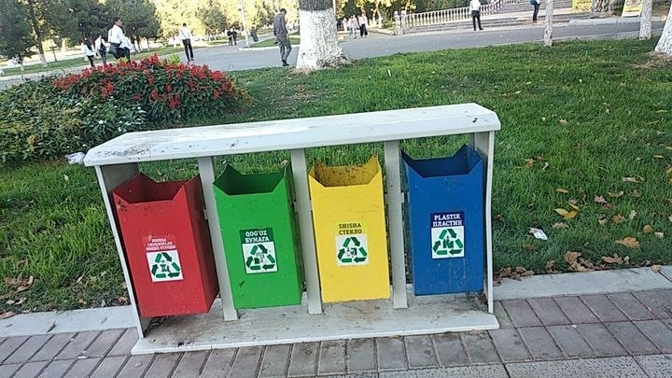
Eco-Smart Bin: Advanced Green Technology for Sustainable Waste Collection
Baseline Income: 4,850 USD
• Revenue / Target ARR: 7,150 USD
• Employees / Team: 5 personnel
History & Description
The “Smart Waste Bin” startup was founded as an innovative green project aimed at solving modern urban waste accumulation and environmental management challenges through digital technology. The idea emerged from the growing need to optimize waste collection processes in smart cities, reduce operational costs, and prevent environmental pollution caused by overflowing public bins. The project began with the development of smart hardware and software systems equipped with specialized sensors to track waste levels in real-time.
Aims and Scope of Work
The primary aim of the startup is to implement automated and intelligent solutions for urban waste sorting and tracking. By integrating internet-of-things (IoT) technology, the project contributes to efficient municipal waste management, reducing carbon emissions from waste collection trucks, and increasing recycling rates. Its broader scope includes designing smart city infrastructures, promoting the principles of the circular economy, and raising environmental awareness among the public through digital monitoring.
Primary Product / Activity
The startup produces and deploys smart waste bins integrated with ultrasonic fill-level sensors, automated sorting systems, and a centralized IoT cloud platform. The automated bins can identify and categorize certain types of waste, compress the trash internally to maximize capacity, and send automated notifications to municipal services when they are full.
The startup’s current operational capacity allows for the assembly, software installation, and deployment of 250 smart bin units annually. Each smart bin installation optimizes collection routes and reduces logistics costs, creating a high economic value with strong potential for large-scale urban implementation. In the long term, the company plans to collaborate with local municipalities, university campuses, and commercial properties to expand smart waste management systems across the region.