Bottom Financial Quintile Admission Target
Bottom Financial Quintile Admission Target
01 | Institutional and national admissions context
Navoi State University was established on the basis of Navoi State Pedagogical Institute under Presidential Resolution PQ-378 dated 31 October 2024. Evidence for the 2024 reference period therefore requires appropriate attribution to the predecessor institution and/or the newly established university, depending on the date and legal continuity of the record.
Admissions in 2024 were administered within Uzbekistan’s centrally regulated higher-education admissions system, with competitive testing and state-funded or tuition-paying places. Nationally prescribed admission privileges may be implemented by institutions without a separately determined institutional quota. This explains the governance setting but does not, by itself, establish an institutional bottom-income-quintile target.
Presidential Order F-43 dated 18 July 2025 establishes national admission parameters for 2025/2026–2028/2029. It is included as later regulatory context only; its provisions must not be retrospectively attributed to 2024.
03 | Economic eligibility: official poverty benchmark
Uzbekistan’s minimum consumer expenditure (MCE) benchmark provides an objective national poverty-related reference. The existing evidence file records UZS 621,000 per person per month in early 2024 and UZS 648,000 from May 2024, citing the Statistics Agency’s 30 April 2024 announcement. The relevant effective dates and source text should be checked against the official record before submission.
Important distinction: an MCE poverty threshold is not mathematically identical to the lowest 20% of the national household-income distribution. Any assertion that MCE-based beneficiaries satisfy the indicator’s “more tightly defined low-income group” condition should be supported by the governing eligibility instrument and the institution’s target.
The later UZS 715,000 benchmark and unified Social Register framework described for 2026 are not evidence of the rules that applied in 2024. They are intentionally excluded from the core reference-year claim.
04 | Subsequent 2025 admission allocations (context only)
Three supplied extracts of 2025 state-funded admission allocations are reproduced once each below. The extracts show allocations attributed to NSU, not confirmed admissions or enrolled students. Their issuing authority, official annex identifiers and source URLs remain to be validated before external submission. Because these records postdate the 2024 reference year, they are contextual evidence only.
Figure 1. Orphans and children deprived of parental care
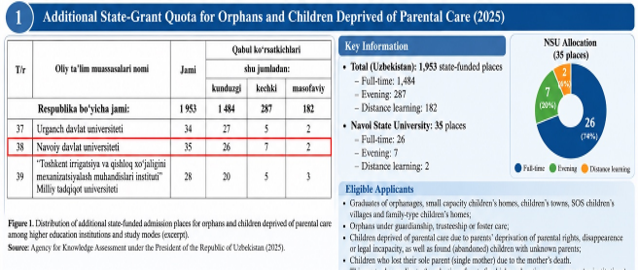
NSU: 35 places (26 full-time; 7 evening; 2 distance). National allocation shown: 1,953. Eligibility is based on parental-care status, not necessarily household income.
Figure 2. Women from socially disadvantaged / low-income families
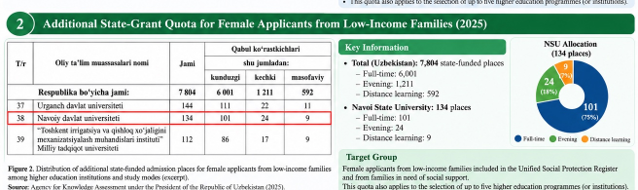
NSU: 134 places (101 full-time; 24 evening; 9 distance). National allocation shown: 7,804. This is the most relevant of the three tables to economic disadvantage, subject to verification of the legal eligibility definition.
Figure 3. Persons with disabilities
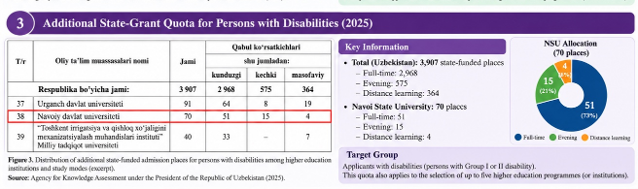
NSU: 70 places (51 full-time; 15 evening; 4 distance). National allocation shown: 3,907. Disability status alone does not establish low household income.
Allocation summary — interpretation and limitations
Category | NSU places | National places |
Orphans / children without parental care | 35 | 1,953 |
Women from disadvantaged families | 134 | 7,804 |
Persons with disabilities | 70 | 3,907 |
Total across three distinct categories | 239 | 13,664 |
The sum of 239 places combines three distinct social-eligibility categories and must not be treated as 239 income-tested places, 239 enrolled students or a 2024 institutional target. Possible beneficiary overlap and the absence of actual admission outcomes prevent a valid beneficiary-count claim. The 134-place women’s allocation is the closest proxy for economic disadvantage, but its precise income-test basis requires the governing eligibility rule.
The separate references to a 4% women’s quota mechanism and a proposed 4,000-grant distribution in later policy documents are not reconciled to the 7,804-place extract. These figures must not be combined or described as identical schemes without their underlying legal annexes.
05 | Evidence relevance and exclusions
Material | Treatment for Indicator 1.3.1 |
2024 income benchmark | Economic eligibility context; not itself an admission target |
2025 women’s quota table | Useful subsequent institution-specific allocation; eligibility requires confirmation |
2025 orphan and disability tables | Inclusion context only; not automatically income-based |
2026/2027 poverty-register admissions guide | Later guidance only; scope and legal applicability require verification |
Student housing, loans and tuition assistance | Post-admission support; exclude from direct admission-target claim |
Remote district preferences and admissions photographs | Not retained as primary evidence because neither establishes an income-targeted admission goal |
06 | Conclusion and source verification
For the 2024 reference period, Navoi State University and its predecessor operated within Uzbekistan’s nationally regulated higher-education admissions framework. The supplied 2025 allocation extracts subsequently identify 35 places for orphans and children without parental care, 134 for women from disadvantaged families and 70 for persons with disabilities. These figures establish later allocation context, not a 2024 university-owned income-based admission target.
The supplied evidence does not demonstrate a formally adopted institutional admission target applicable in 2024 for applicants in the lowest national household-income quintile or a demonstrably narrower low-income group. Accordingly, the material should not be presented as proof of full compliance with Indicator 1.3.1. Obtain an authentic dated institutional policy or an authoritative equivalent record before making that claim; otherwise retain this limitation in the submission.
Primary-source register and outstanding verification
Reference | Status / action |
PQ-378 (31 October 2024) | Founding instrument; cite official publication and exact article/paragraph when confirmed. |
2024 Statistics Agency MCE notice | Verify 621,000 / 648,000 UZS figures and effective dates against dated Statistics Agency publications; insert direct links. |
F-43 (18 July 2025) | Subsequent policy only; official legal database link: https://lex.uz/uz/docs/-7636839 (confirm citation and scope). |
2025 quota tables (three extracts) | Original annex, issuing authority, publication date, relevant page, and public URL are not yet provided. The embedded extracts alone are not fully traceable. |
Appendix A — Women from families requiring social protection
The guidance excerpt describes recommendation-based access to additional state-funded admission quotas for eligible women from socially disadvantaged families, citing Presidential Resolution PQ-5020 (5 March 2021) and Cabinet Resolution No. 402 (23 June 2020). This is a national eligibility mechanism; the excerpt does not establish a 2024 NSU-specific income-quintile admission target.
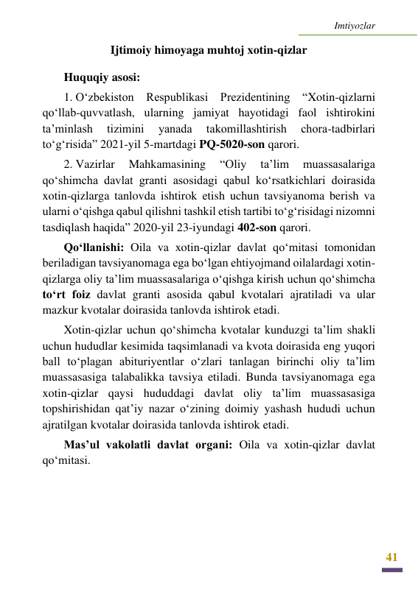
Reproduced admissions-privileges guidance, printed page 41. Edition identified in the preceding evidence dossier as 2026/2027; official source URL and edition require verification.
Evidence classification: supplementary national policy context; not primary 2024 institutional-target evidence.
Appendix B — Applicants registered in the Register of Poor Families
The guidance excerpt describes additional state-funded admission eligibility for children of families included in the Register of Poor Families, including an examination-score threshold of 80% of the state-grant passing score. This is a poverty-related admission category, but the excerpt references later regulatory arrangements and cannot retrospectively demonstrate NSU policy in 2024.
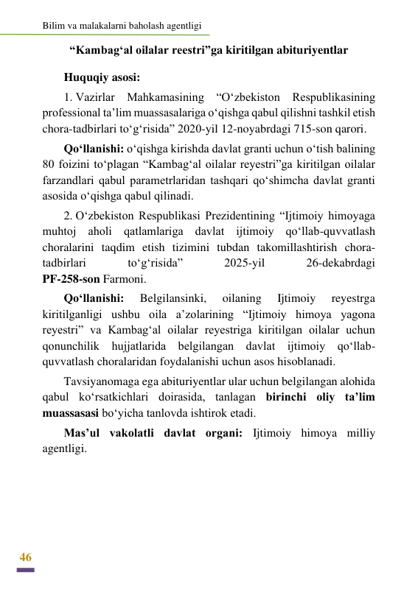
Reproduced admissions-privileges guidance, printed page 46. Edition identified in the preceding evidence dossier as 2026/2027; official source URL and edition require verification.
Evidence classification: supplementary national policy context; not primary 2024 institutional-target evidence.
Bottom Financial Quintile Student Graduation / Completion Targets
01 | What the indicator requires
The operative subject is an institutional target to graduate students from the bottom financial quintile (the lowest 20% of the household income distribution). An admissions quota, grant eligibility rule, general welfare activity or graduate employability project is not, by itself, evidence of such a target. The institution should show a formally adopted target, its covered cohort, a baseline, a period, monitoring responsibility and, ideally, actual completion outcomes.
02 | Institutional development and legal framework
Presidential Resolution PQ-378 (31 October 2024)
Clause 4 of Presidential Resolution PQ-378 approves the Comprehensive Development Programme of Navoi State University for 2024–2027 as Annex 1. The resolution thus establishes an official institutional planning framework. However, the source available for this dossier confirms the programme’s approval, not the precise text of its social inclusion or graduation provisions.
Source: PQ-378, 31 October 2024, clause 4. https://nrm.uz/contentf?doc=763548_postanovlenie_prezidenta_respubliki_uzbekistan_ot_31_10_2024_g_n_pp-378_o_merah_po_obrazovaniyu_navoiyskogo_gosudarstvennogo_universiteta&products=1_vse_zakonodatelstvo_uzbekistana
Reported institutional priorities — pending source verification
The university description supplied for preparation identifies two intended priorities: (i) sustaining material and non-material support for financially disadvantaged students until graduation, and (ii) reducing financial reasons for withdrawal, including tuition-payment difficulties and associated academic risk. These are potentially relevant to completion. They are recorded here as institution-reported descriptions only; the exact approved wording and operational targets have not been independently confirmed.
Priority | Potential link to completion | Proof still needed |
Support until graduation | Addresses financial persistence barriers | Approved programme extract / order |
Targeted assistance for at-risk students | May reduce withdrawals and delayed completion | Beneficiary lists, eligibility criteria and reports |
Accommodation / rent assistance | May lower living-cost pressures | Rector order, payment evidence |
Career and employer engagement | May help transition from study to work | Career-centre reports, completion-linked outcomes |
03 | Evidence extracted from uploaded 2026–2027 guidance
Two uploaded language versions of the admission benefits guide, together with a four-page university summary, describe national admissions concessions. The Uzbek and English guides are parallel versions, not independent confirmation of separate university programmes. Their date is later than the 2024 baseline and must be labelled accordingly.
Guide category | What the source establishes | Relevance / limitation |
Register of Poor Families (guide p. 46) | Applicants from registered families reaching 80% of the grant passing score may qualify for additional state-grant admission outside ordinary quotas. | Strong poverty-related ACCESS context; does not establish graduation or completion target. |
Women requiring social protection (guide p. 41) | Separate admissions-related support for eligible women. | Eligibility category does not automatically equal bottom 20% by income. |
Persons with disabilities (guide p. 39) | Additional state-grant admissions route subject to stated criteria. | Disability cannot be treated as a proxy for household income quintile. |
Children deprived of parental care (guide p. 40) | Separate admission privileges for defined groups. | Access measure; not completion target. |
Remote desert districts (university summary) | Special grants for qualifying residents of Konimex, Tomdi and Uchquduq districts. | Geographic eligibility is not income-quintile classification. |
04 | National framework for final graduation assessment
Cabinet of Ministers Resolution No. 836 of 13 December 2024 introduces, from 1 January 2025, the practice of organising final state attestation also at employer organisations. The regulation sets a framework for assessing graduates, and describes a graduate in relation to curriculum completion, earned credits and completed practical training. This is relevant context for the final stage of education, but does not define a low-income graduation target or prove that a specific Navoi State University cohort completed its studies.
Official legal source: https://lex.uz/docs/-7267040 — Resolution No. 836, 13 December 2024, clause 1 and Annex 1.
05 | Financial support, retention and employability: source hierarchy
Student scholarships, rent support, accommodation access, rector-approved aid and career-centre services are plausible retention mechanisms. The university description mentions these activities, and the previous evidence inventory identified related public communications. They should not be represented as verified university-wide programmes, actual disbursements or 2024 results without checking the underlying orders, publication dates and beneficiary counts.
Possible evidence | How it could be presented | Verification threshold |
Official scholarship announcement | Operational mechanism for continued study | Dated university post and exact eligibility |
Rental / residence support | Living-cost support for students | Order, period, beneficiary number |
Rector / University Council decision | Institutional ownership and accountability | Signed decision and section text |
Career centre / employer partnership | Transition and practical learning support | Published programme and outputs |
Academic support / tutor records | Retention interventions | Cohort tracking and measured effects |
05A | Photographic evidence of direct social support
The three photographs below are reproduced from the final page of the uploaded “SDG 1 Report” (Annual Progress Report on the Goals and Targets We Committed 2023–2024, Navoi State Pedagogical Institute). They depict institutional representatives visiting households and engaging with people in need, including a young wheelchair user. The accompanying report describes identification of economically disadvantaged students and assistance with tuition, accommodation, food and transport. These photographs support the narrative of institutional outreach and social assistance; they do not by themselves verify an income-quintile graduation target or completion outcome.
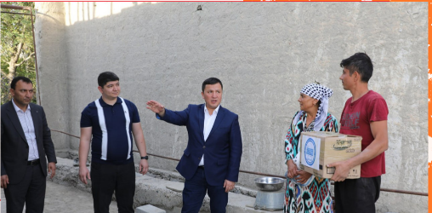
Figure 1. Institutional representatives visiting a household and delivering assistance.

Figure 2. An institutional representative engaging with a young wheelchair user during a support visit.
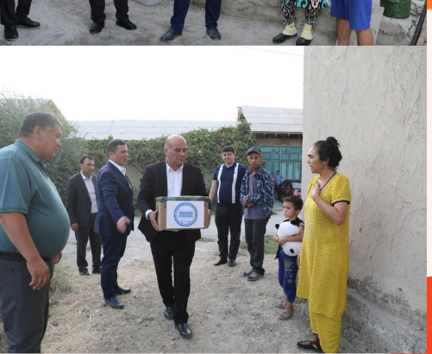
Figure 3. Representatives visiting another household and providing assistance.
06 | Evidence and chronology control
Period | Document or event | Treatment |
2024 | PQ-378 and establishment / development framework | Verified legal context, not outcome |
2025 | Resolution 836 implementation from 1 January | National final-attestation framework |
2026–2027 | Uploaded admissions benefits guides | Later policy context, not 2024 graduation performance |
2026 submission | SDG 1.3.2 dossier | Claims must be tied to accepted reporting window and evidence |
07 | Submission-ready interpretation
Navoi State University operates within a legally established 2024–2027 institutional development framework and a national higher education environment that provides targeted admission privileges for certain socially disadvantaged categories. The available guidance documents show that applicants from registered poor families can be eligible for an additional grant-based admissions route, while separate arrangements address disability, parental-care status and social vulnerability. These measures are relevant to widening participation and potentially to subsequent persistence. They do not, however, prove a university-specific graduation target for students in the bottom household-income quintile. Until the approved programme provisions, an institutional decision or completion data are supplied, the graduation-target component of SDG 1.3.2 should be reported as not yet independently substantiated.
08 | Source register
[S1] Presidential Resolution PQ-378, 31 October 2024, clause 4 — approval of 2024–2027 programme; public legal reproduction: https://nrm.uz/contentf?doc=763548_postanovlenie_prezidenta_respubliki_uzbekistan_ot_31_10_2024_g_n_pp-378_o_merah_po_obrazovaniyu_navoiyskogo_gosudarstvennogo_universiteta&products=1_vse_zakonodatelstvo_uzbekistana
[S2] Cabinet of Ministers Resolution 836, 13 December 2024, official LexUZ: https://lex.uz/docs/-7267040
[U1] English admission privileges guide, 2026–2027, supplied DOCX, pp. 39–46.
[U2] Uzbek admission privileges guide, 2026–2027, supplied DOCX and PDF, pp. 39–46.
[U3] University admissions summary, “Qisqacha ma’lumot(2).docx”, supplied DOCX.
[P1] University-reported strategic and operational descriptions supplied by project coordinator; not independently validated against original orders.
09 | Verified administrative records of targeted student assistance
The two university-provided administrative records are analysed below. Image spaces are intentionally left blank so the university can insert the correct original page images after removing personal identifiers. These records evidence financial support processes, not a quantified bottom-quintile graduation target.
10 | Food, clothing, footwear and essential supplies for students under state care (2026)
Institutional calculation for providing students under state care, including orphans and students deprived of parental care, with food, clothing, footwear and other essential supplies. The schedule lists 10 students, their years of study, supporting eligibility documents and itemised amounts for the relevant forms of provision. Its total calculated amount is UZS 121,116,639. This is a planned/calculated allocation shown in the document, not independently verified evidence that the full amount was paid or delivered. Students under state care must not automatically be classified as belonging to the bottom household income quintile.
Evidence type | University administrative calculation of support-related costs |
Coverage | 10 student entries |
Reported total | UZS 121,116,639 (calculated aggregate; not verified as disbursed) |
Relevance to SDG 1.3.2 | Documents potential financial barriers being addressed for supported students, which may facilitate continued enrolment and eventual completion |
Limitations | No graduation target, no beneficiary-level graduation outcome, no confirmed income-quintile classification |
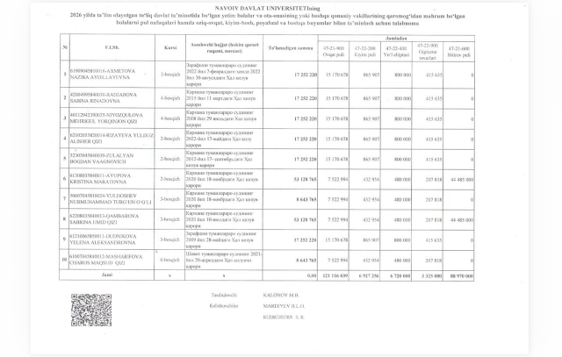
Detailed description — essential living support and relevance to SDG 1.3.2
The 2026 calculation demonstrates a concrete administrative mechanism through which Navoi State University plans material provision for students under state care. Its scope includes food, clothing, footwear and other necessary supplies rather than merely tuition discounts or general cash assistance. Meeting these basic living needs can ease day-to-day financial pressures on students who lack parental support, helping create conditions for regular attendance, sustained engagement in academic activities and continued enrolment through to graduation. The student-level schedule, course information and documented eligibility provide an administrative starting point for tracking whether beneficiaries remain enrolled and eventually complete their programmes. In the context of THE Impact Rankings indicator 1.3.2, this is relevant supporting evidence of a retention-oriented social protection measure. However, the document does not specify a graduation/completion target for students from the lowest 20% of household incomes, does not show actual distribution of every listed item, and does not report graduates or completion rates. Any direct claim of improved graduation outcomes would require additional cohort-level evidence.
10.2 | Annual book-purchase subsidy for orphans and students deprived of parental care
Source document: “Subsidiya.PDF”, a one-page official information sheet prepared by Navoi State University. It identifies 26 student entries relating to orphans and students deprived of parental care who are eligible for state-budget subsidies for purchasing educational, scientific and literary books. The stated scheme provides a subsidy once per academic year during enrolment, in an amount equivalent to five times the Base Calculation Amount (BHM). The register records students’ courses, eligibility categories, supporting documents and subsidy amounts. It is a book-purchase subsidy, not a tuition-fee, accommodation or general living-expense payment.
Evidence type | Institutional student subsidy register |
Coverage | 26 numbered entries |
Supporting fields | Study year, social category, decision/legal basis and subsidy amount |
Relevance to SDG 1.3.2 | Evidence of an operational mechanism for targeted financial relief during study |
Limitations | No verified disbursement date for each entry, no matched graduation outcomes, no bottom-income-quintile classification |
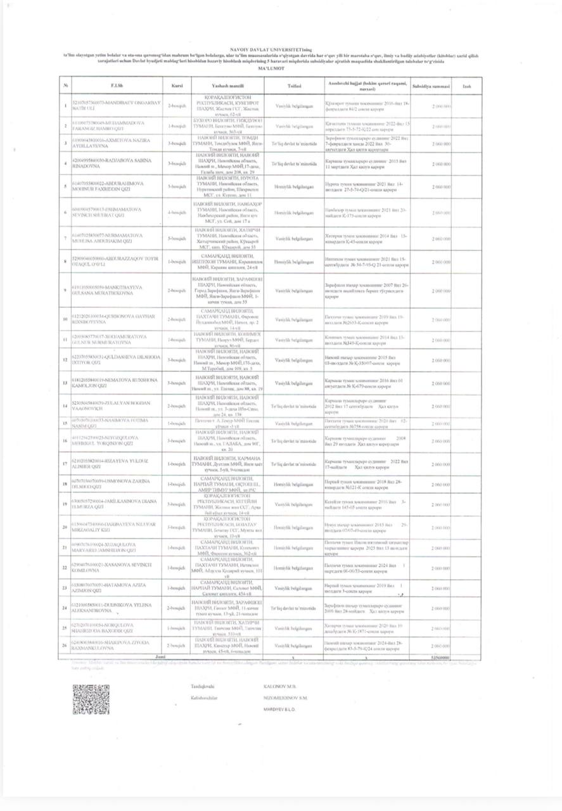
Detailed description — annual book-purchase subsidy and its relevance to SDG 1.3.2
Navoi State University’s “Subsidiya” information sheet documents a specific educational-support mechanism for orphans and students deprived of parental care. During their period of study, eligible students are provided for under a state-budget subsidy arrangement intended to help them purchase educational, scientific and literary literature (books) once in each academic year. The amount specified in the document is five times the applicable Base Calculation Amount (BHM). The register contains 26 student entries and records the eligibility and administrative basis for the subsidy. Access to required textbooks, reference materials and wider academic reading can help students participate in coursework, prepare for examinations and sustain academic progress without bearing the full cost of these resources. This provides a plausible pathway by which educational-material support may contribute to retention and eventual degree completion. For THE Impact Rankings indicator 1.3.2, the register is therefore supporting evidence of a targeted measure addressing educational costs for a vulnerable student group. It is not direct evidence of a graduation or completion target for students in the bottom 20% of household income, nor does it report recipients’ actual graduation outcomes. Orphanhood or loss of parental care should not be assumed to establish bottom-income-quintile status without separate income-based classification. The university would need an approved completion target and linked cohort-level graduation records to demonstrate the indicator fully.
10.3 | Evidence-to-outcome monitoring proposal
Existing evidence | Follow-up administrative dataset | Indicator enabled |
State-supported student calculations | Verified assistance disbursement and enrolment records | Number of supported students retained |
Subsidy register | Subsidy decisions linked to subsequent semester registration | Continuation rate of subsidy recipients |
Both registers | Graduation lists and approved definition of bottom income quintile | Graduation/completion rate of eligible low-income cohort |
University development plan | Approved, dated, measurable graduation target | Institutional target and performance gap |
Methodological note: The state-care essential-needs calculation and the annual book-subsidy register cover different types of support. Recipients may overlap; do not add the student counts together as a count of unique beneficiaries without record matching. These records do not themselves establish household-income-quintile status or graduation outcomes. No personal identifiers are reproduced in this dossier.
Support for Students from Low-Income Families
Institutional overview
Navoi State University recognises that financial vulnerability may affect students not only through tuition expenses but also through housing instability, daily living costs and difficulties accessing practical information. This evidence portfolio documents publicly verifiable university accommodation facilities and the dissemination of official rental-compensation guidance. It also provides clearly labelled spaces for institutional records of direct material assistance, food support, counselling and transport, where such activities can be substantiated. The distinction is important: availability of a campus service does not, by itself, prove that the service is reserved for students in the bottom household-income quintile. Accordingly, targeted eligibility, uptake and outcomes should be demonstrated through university records rather than inferred from photographs.
Official source: https://ndu.uz/student-life-accommodation.html
Student accommodation and essential living facilities
Figure 1. Student accommodation facilities at Navoi State University, offering residential infrastructure and essential amenities that can help students maintain stable living and learning conditions.
Student accommodation is a fundamental part of an inclusive university environment because secure and predictable housing enables students to attend classes, participate in academic activities and maintain a consistent study routine. Navoi State University’s official accommodation page describes residential provision and everyday facilities, including spaces for preparing food, studying and accessing internet services. Such infrastructure can reduce the practical burden of arranging accommodation and basic amenities independently, particularly for students who relocate from other districts. For this indicator, the photograph should illustrate the actual facilities, while any claim that low-income applicants receive priority, a reduced fee or a guaranteed place must be supported by a published allocation rule or an authorised university record. Where available, insert the reporting-year number of students accommodated, the fee schedule and the number of recipients identified through verified socioeconomic criteria.
Source: https://ndu.uz/student-life-accommodation.html
2. Rental-cost compensation and housing guidance
The university’s official Telegram channel circulated guidance on Uzbekistan’s scheme for partial reimbursement of eligible students’ rental expenses, citing Cabinet of Ministers Resolution No. 605 of 24 September 2021. The announcement explains that students should submit an online application by the seventh day of each month through their account at kontrakt.edu.uz, selecting the rental-payment section. It also distinguishes documentation requirements for first-year students in September and October from those applying in later years of study. Making this information accessible can help students who cannot secure a dormitory place navigate an important form of housing-related financial support. This is evidence of university communication and referral to a public support mechanism; it should not be described as proof of payments made by NSU. To establish implementation and reach, add a university-certified summary of approved applications, total reimbursement and beneficiaries from low-income households for the relevant reporting period.
3. Financial and material assistance
Direct financial or in-kind assistance can address short-term hardship that otherwise interferes with students’ ability to purchase learning materials, meet necessary living expenses or remain enrolled. This section is reserved for a verified NSU programme, such as an officially approved one-off hardship payment, targeted assistance to socially vulnerable students or a documented distribution of essential supplies. The final evidence should identify the authorising office or decision, eligibility and application criteria, the period of implementation, the number of student beneficiaries and, where disclosure is appropriate, the total value of assistance. Photographs should be captioned with the real event name and date, not treated as standalone proof of household-income eligibility. Until these details are supplied, this section describes the evidence required rather than claiming that a particular NSU scheme operated.
4. Food and essential-needs assistance
Figure 4. Food or essential-needs assistance delivered to eligible students.
Food insecurity and unmet basic needs may undermine concentration, health and participation in university life. If NSU has delivered free meals, food parcels or other essential-needs assistance to financially vulnerable students, the relevant evidence should describe how students were identified, whether assistance was recurring or emergency-based, how support was distributed and which university unit was responsible. The photograph placeholder may be used for a genuine food-support activity, accompanied by its date and a link to the university announcement or an subsidized internal report. An ordinary student cafeteria photograph demonstrates food-service infrastructure only; it does not prove that meals were provided free of charge or subsidized for low-income students. Remove this section if no targeted programme can be verified.
5. Student counselling, welfare and legal guidance
Figure 5. Student welfare and advisory services supporting access to practical and personal assistance.
Financial hardship can intersect with accommodation disputes, administrative difficulties, personal stress and limited awareness of available public benefits. Accessible student-welfare, psychological and legal-advice services can help students understand their options, resolve problems early and obtain referrals before difficulties disrupt their education. To make this section an institutional evidence item, NSU should document the specific service unit, access channel, hours or consultation arrangements, and any policy ensuring accessibility for economically disadvantaged students. A photograph of a meeting or counselling room is helpful only when paired with a verified description of the actual service and its intended beneficiaries. Do not state that legal advice or dedicated low-income case management is available unless the university confirms it.
6. Transportation and access support
Figure 6. Transport-related assistance supporting student access to university.
Travel costs may represent a significant recurring expense for students commuting from rented accommodation or surrounding districts. Where NSU provides a free shuttle, travel subsidy or another documented transport-access arrangement, this section should describe the routes or eligibility rules, responsible office, operating period and evidence of student use. The relationship to completion should be explained in practical terms: reliable, affordable travel can support attendance at classes and assessments. However, public transport operating near campus, or photographs of vehicles alone, cannot establish university-provided support. Retain this section only if an NSU-administered or NSU-facilitated benefit is confirmed by an official announcement or record.
Additional institutional development
In a public announcement issued in 2026, Navoi State University described a proposed public-private partnership project to construct an 800-place student residence in the Yoshlik neighbourhood of Navoi. The published project information includes an indicative monthly residence charge of UZS 440,000 and a planned implementation period of one year and four months. This demonstrates forward planning for additional accommodation capacity, but it is not evidence that the planned places were already available to students in the reporting year. The proposal should therefore be presented only as contextual information and should not substitute for records of current services or targeted low-income support.
Source: https://ndu.uz/news-talabalar-turar-joyi-dxsh-loyihasi-jamoatchilik-muhokamasi.html
Support for Students from Low-Income Households
Institutional context and evidence approach
Navoi State University was established on the basis of Navoi State Pedagogical Institute under Presidential Resolution PQ-378 (2024). The university’s financial autonomy, effective from 1 January 2025 as described in the institutional context, provides a basis for managing institutional resources and considering targeted student assistance. The existence, scope and 2025 disbursements of a dedicated student incentive or support fund must be substantiated by university regulations, orders or financial reports.
Programme overview
Support pathway | Intended contribution | 2025 institutional evidence needed |
Youth Register tuition assistance | Reduce immediate tuition-payment barriers | NSU beneficiary confirmation or referral records |
Material assistance / institutional funds | Address urgent financial hardship and essential study costs | Rector orders, fund regulations, anonymised totals |
Preferential education loans | Improve access to tuition financing | NSU information and application support evidence |
Tutor-based follow-up | Identify at-risk students and coordinate assistance | Tutor reports, referral procedures and outcomes |
1. Targeted tuition-fee assistance: Youth Register
The Youth Register (Yoshlar daftari) is a public support pathway for eligible young people facing social or economic disadvantage. Eligible students may apply for assistance towards tuition fees subject to the applicable rules, caps, eligibility tests and budget arrangements in force at the time. The figures of up to 50% of tuition and up to 50 basic calculation units have been supplied for this portfolio but should not be presented as verified 2025 entitlements without the dated legal source.
2. Material assistance and institutional financial autonomy
Financially vulnerable students may seek one-off or periodic material assistance subject to applicable university procedures, rector’s orders and relevant trade-union or institutional decisions. Eligibility may be informed by recognised social protection records such as the Youth Register, Women’s Register, Iron Register or Unified Social Protection Register, where relevant. The university’s financial autonomy provides institutional context, but does not by itself prove that a particular fund or allocation was used for students in 2025.
Contribution to retention and completion
Documented grants or material assistance can help students meet essential living and study costs, thereby reducing pressure to suspend their studies
Preferential education loans
State-supported education loans offer another route for full-time tuition-paying students to manage educational expenses. Loan conditions may differ by borrower category and date. The statements supplied regarding subsidised interest for female students, a 14% rate for male students, repayment duration and reduced collateral requirements for eligible low-income households must be checked against the regulations and bank terms effective in 2025 before they are presented as precise entitlements.
4. Tutor-based academic and welfare support
University tutors can monitor attendance and academic progress, identify students experiencing financial or social hardship and direct them towards appropriate support channels, including financial aid, student accommodation and education-loan guidance. The targeting and frequency of such interventions should be evidenced through university tutor instructions, referral logs or anonymised reports.
Contribution to retention and completion
Coordinated academic and welfare follow-up can identify early signs of disengagement and enable timely intervention.
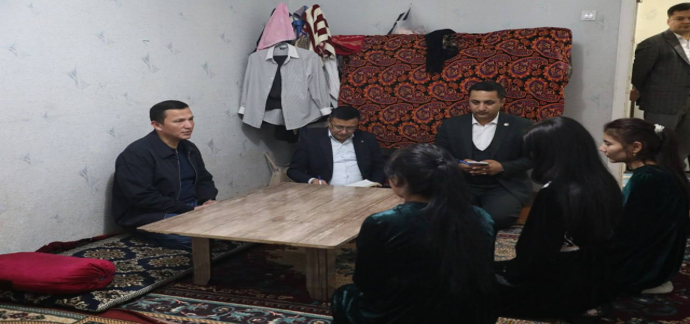
5. Regional assistance: contextual evidence only
Local government assistance may complement national programmes. A reported allocation in Navoi Region of UZS 3.78 billion for 856 students has been provided as contextual information; its source, date, eligibility and institutional coverage remain unverified. This regional figure must not be described as an NSU allocation or as the number of NSU student beneficiaries unless an official breakdown confirms it.
Support schemes for students from low- and lower-middle-income countries
Institutional evidence statement
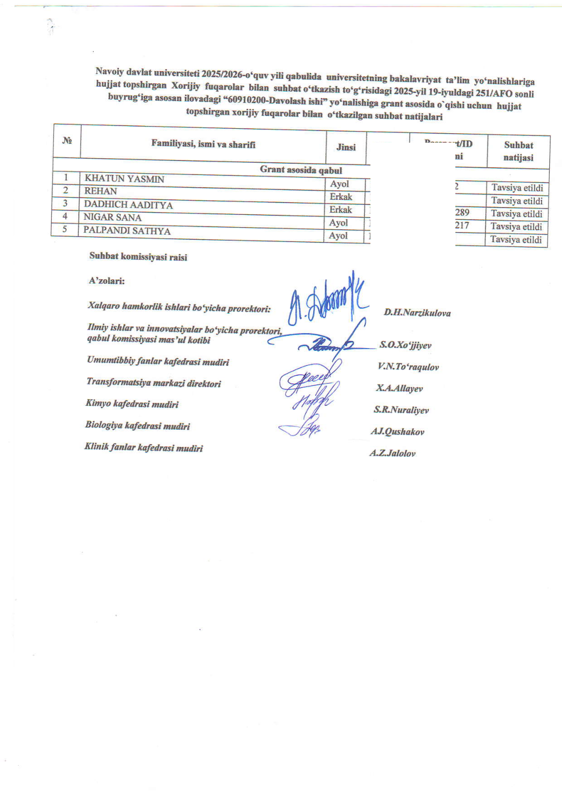
Navoi State University (NSU) has documented a grant-based admissions pathway for international applicants in the 2025/2026 academic year. An interview commission recommendation, issued pursuant to Order No. 251/AFO of 19 September 2025, lists five applicants from India for grant-based admission to the English-medium, full-time General Medicine programme (60910200). The recommendation is signed by commission members.
A subsequent rector’s Order No. 503-K/B, dated 5 November 2025, concerns admission of foreign applicants on state grants and directs the enrolment of candidates recommended for grants. However, its annex lists the same five applicants under fee-paying admission. This inconsistency requires official clarification before the five students can be reported as confirmed grant recipients.
Moreover, the university provides free accommodation for all international students.
Evidence at a glance
Evidence dimension | Verified information | Status |
Target country | India — lower-middle-income economy under the 2025 World Bank classification | Country criterion supported |
Target programme | General Medicine (60910200), full-time, English-medium | Documented |
Grant recommendation | Five Indian applicants recommended for grant-based admission | Documented |
Final funding status | Rector order title refers to grants; annex states fee-paying admission | Clarification required |
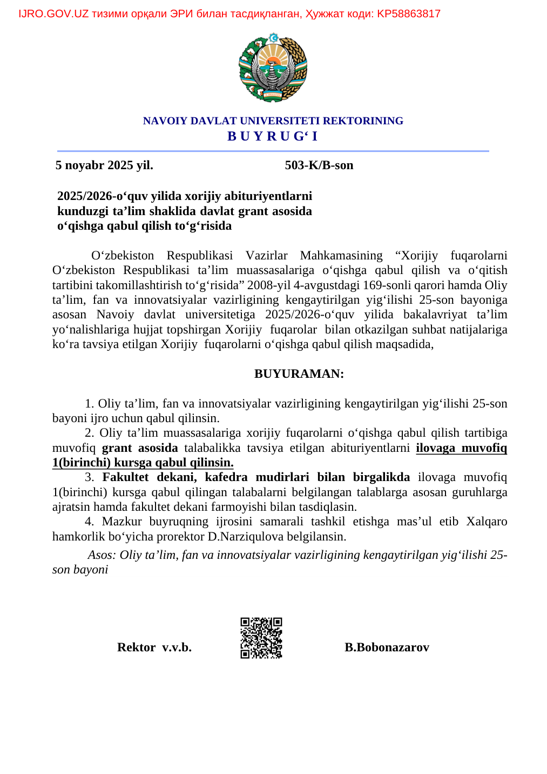
Figure 1. Rector’s order on the admission of foreign applicants, 5 November 2025.
Documentary evidence — admission annex
The annex lists five applicants from India in the General Medicine programme. Personal identification numbers have been obscured in this evidence portfolio.
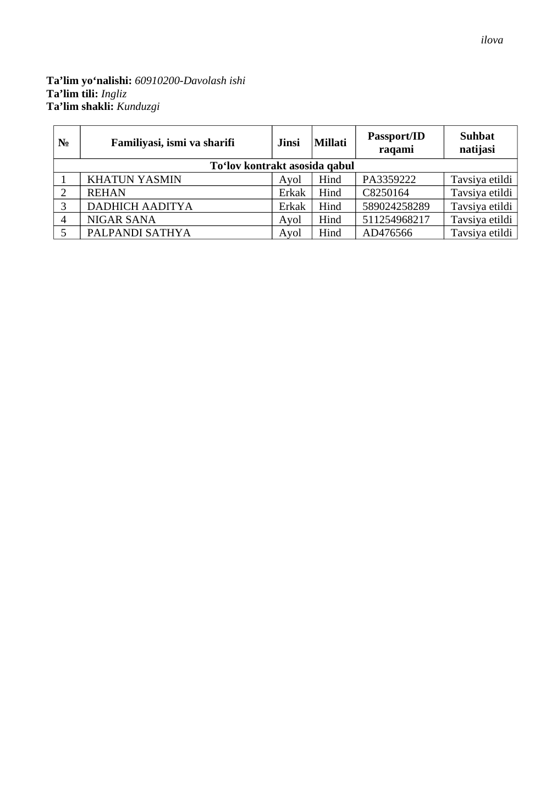
Figure 2. Annex to Order No. 503-K/B, showing five Indian applicants; funding label requires clarification.
Documentary evidence — grant recommendation
The signed interview commission recommendation expressly uses the heading “Grant asosida qabul” (grant-based admission) for five Indian applicants. It is evidence of recommendation, not definitive evidence of disbursed grants.